This post is also available in:
 עברית (Hebrew)
Legged robots have become increasingly capable in recent years, but most advanced quadruped systems remain expensive, complex, and difficult for students, hobbyists, and researchers to access. Building smaller robots often introduces another challenge: the wiring, electronics, and mechanical systems can become so crowded that reliability and maintenance suffer.
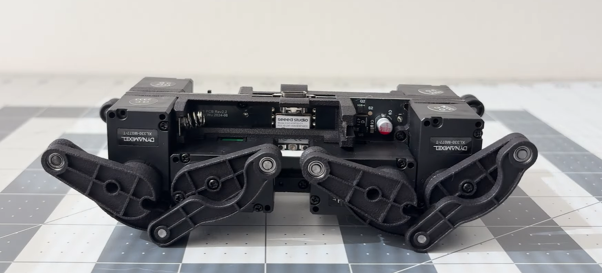
A new open-source quadruped robot (named Q8botOne) aims to address those issues with a highly integrated design that packs advanced locomotion capabilities into a platform small enough to fit in the palm of a hand. Despite its compact size, the robot can walk, trot, and jump, bringing dynamic movement typically associated with much larger robotic systems into a more accessible format.
The robot achieves this through a combination of eight programmable smart actuators and a lightweight mechanical structure. Each leg uses a parallel-linkage design constructed from Multi Jet Fusion (MJF) 3D-printed components and precision ball-bearing joints. This arrangement provides strength and accuracy while keeping weight low enough to support agile movement.
According to Interesting Engineering, one of the most distinctive aspects of the platform is its electronics architecture. Rather than routing cables throughout the body, the robot integrates most of its electronics directly onto a custom central printed circuit board. This significantly reduces wiring complexity, lowers weight, minimizes potential failure points, and simplifies maintenance.
At the center of the system is an ESP32-C3 microcontroller responsible for robot control and onboard processing. Power is supplied by a rechargeable lithium-ion battery with integrated protection circuitry. Together, these components create a fully assembled platform that can be operated immediately without requiring users to source and assemble individual parts.
The robot also includes expansion interfaces designed for more advanced applications. A Qwiic-compatible connector allows users to add external sensors with minimal wiring, while a dedicated UART interface supports co-processors such as Raspberry Pi computers. This enables projects involving computer vision, AI, autonomous navigation, and robotics research.
From a defense and security perspective, compact legged robots are attracting growing interest for reconnaissance, inspection, and autonomous sensing missions in confined environments. Open platforms can also accelerate experimentation with mobility algorithms and autonomous behaviors that may eventually transfer to larger robotic systems.
The project remains fully open source, with hardware designs, firmware, and schematics expected to be released publicly. By lowering both cost and technical barriers, the platform could make advanced quadruped robotics accessible to a much broader community of developers and researchers.