

This post is also available in:
 עברית (Hebrew)
Modern warfare is increasingly shaped by technologies that operate beyond traditional bullets and bombs. As conflicts move into dense urban areas and contested electromagnetic environments, militaries are looking for tools that can sense, decide, and act faster—sometimes without relying on constant human control. This shift has brought renewed attention to several emerging capabilities that could redefine how future battles are fought.
According to the New York Post, one of the most discussed—and controversial—areas involves so-called “invisible” weapons. Over the past decade, a cluster of unexplained neurological symptoms known as Havana Syndrome has affected diplomats and officials in multiple countries. The symptoms resemble brain injury, and some analysts suspect exposure to directed energy, such as radiofrequency or acoustic waves. Recent reporting suggests that the Pentagon has acquired a device believed to replicate similar physical effects, although its origin, exact function, and operational status remain unclear. Regardless of the unanswered questions, the episode highlights growing interest in non-kinetic tools that can incapacitate without visible damage.
Alongside this mystery, more transparent technologies are already reshaping the battlefield. Unmanned aerial systems have become central to modern combat, particularly small, low-cost drones that can strike targets or gather intelligence. The latest evolution focuses on autonomy and swarming. Instead of relying entirely on a live data link to an operator—something easily jammed—new drones are being designed to continue their mission or return safely even if communications are disrupted. Coordinated swarms can overwhelm defenses by sheer numbers, posing a challenge to traditional air defense systems.
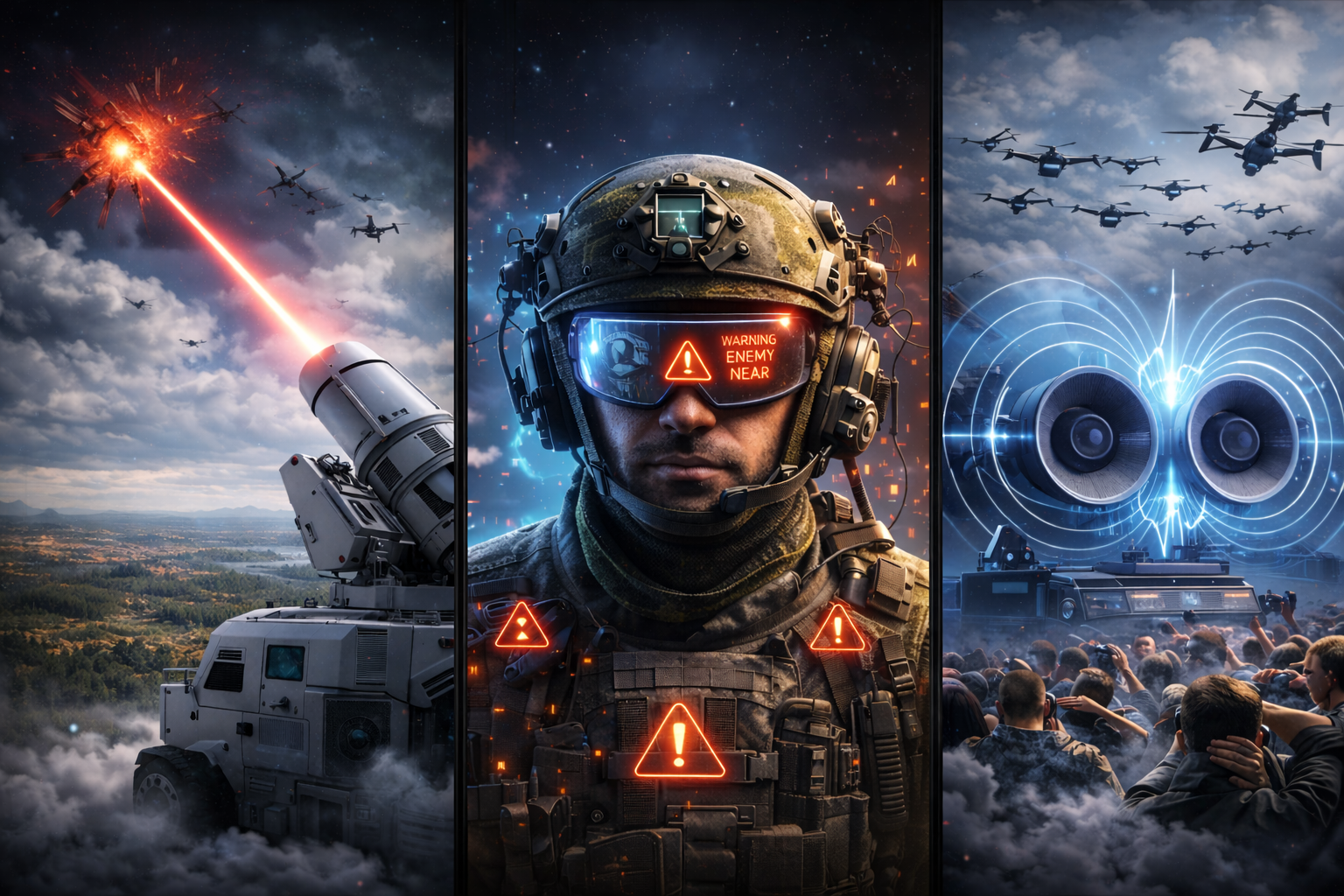
At the individual soldier level, situational awareness is also being transformed. Advanced combat helmets are moving beyond protection to become digital interfaces. Equipped with heads-up displays and sensors, these systems can highlight threats, distances, and hazards in real time. By feeding soldiers processed battlefield data directly into their line of sight, such helmets aim to improve decision-making under stress while reducing cognitive overload.
Non-lethal but physically disruptive technologies are another area of focus. Long-range acoustic devices emit highly directional sound at painful intensities, capable of dispersing crowds or incapacitating individuals without conventional weapons. These systems are already used for area denial and perimeter security, though their effects and appropriate use remain subjects of debate.
Finally, directed-energy defenses are advancing rapidly. Laser-based interception systems promise to neutralize incoming rockets or drones using focused energy rather than expensive interceptors. By pairing sensors with high-energy lasers, these systems aim to reduce costs and response times in missile and drone defense.
Together, these developments illustrate a broader trend: future warfare will rely as much on sensing, autonomy, and energy-based effects as on traditional firepower. Whether defensive or offensive, these technologies are expanding the definition of what a weapon can be—and how it shapes the modern battlefield.























