

This post is also available in:
 עברית (Hebrew)
As unmanned systems become more common, the challenge is no longer just flying a drone, but managing many of them at once. In current operations, complex missions often require multiple operators, separate control stations, and constant handoffs—especially when different types of drones are involved. This fragmentation slows decision-making and makes it harder to maintain a clear picture of what is happening on the ground or in the air.
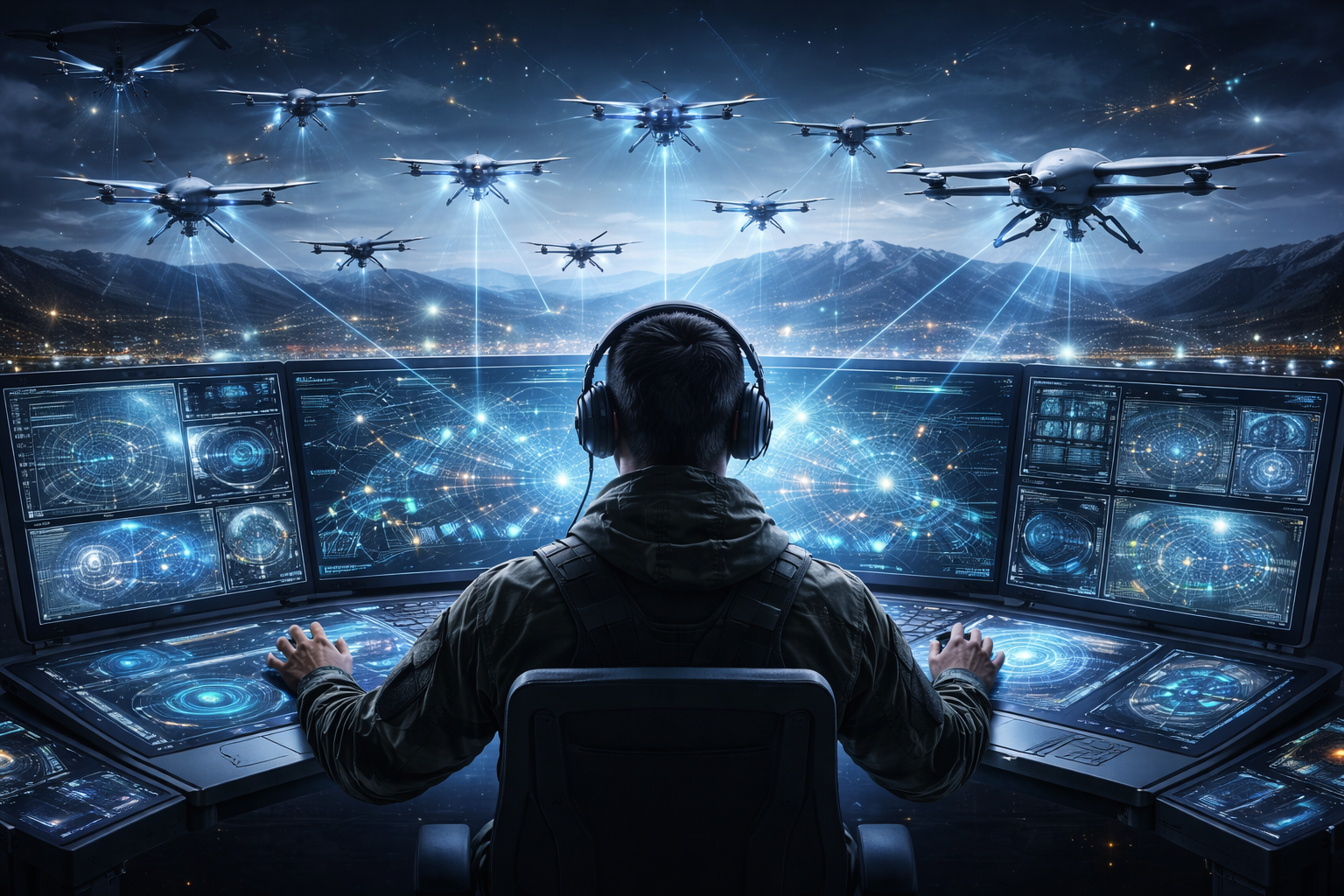
A newly tested control concept is designed to simplify that problem. By combining an autonomy framework with an intuitive operating system, the approach allows a single operator to manage multiple classes of drones from one workstation. The integrated setup merges Skunk Works’ MDCX autonomy platform with XTEND’s XOS operating system, creating what is described as a Multi-Class MDCX workstation. The idea is to centralize control, reduce operator workload, and improve situational awareness during complex missions.
According to NextGenDefense, in a recent demonstration, the system showed how this works in practice. One operator controlled a mission in which a larger drone deployed a smaller unmanned aircraft to perform a close-range task. Under previous concepts, control of the smaller drone would typically be handed off to another operator using first-person views and separate interfaces. With the integrated workstation, the same operator remained in charge of both platforms, maintaining continuous oversight without switching systems or roles.
Joint and multi-domain operations increasingly rely on unmanned systems for reconnaissance, security, and precision tasks. Being able to control several drones—potentially with different roles and payloads—from a single interface supports faster execution at lower command levels, a key requirement in joint all-domain command-and-control (JADC2) environments.
The system plays a central role in lowering the barrier to multi-drone control. It is designed so that new operators can perform at near-expert levels with less training. Its interface simplifies complex actions, while integrated AI allows drones to carry out sub-tasks autonomously. The human operator focuses on mission-level decisions, stepping in when judgment or adaptation is required.
The architecture is platform-agnostic and open, allowing integration with third-party hardware, flexible payloads, and different command-and-control systems. It also supports swarm-style operations, enabling operators to shift smoothly between manual control and autonomous behaviors as missions evolve.
Together, these elements point toward a future where unmanned missions are managed more like coordinated teams than individual vehicles. By reducing the need for multiple operators and consoles, the new control concept aims to make complex drone operations more efficient, scalable, and accessible across a wide range of scenarios.























