This post is also available in:
 עברית (Hebrew)
InteliATE is a graduate of the INNOFENSE Innovation Center operated by iHLS in collaboration with IMoD. This unique acceleration program removes entrance barriers to the technological ecosystem, turning startups into mature, leading companies while connecting them with relevant investors, which is designed to strengthen the links between the civilian and defense markets via the collaborative development of the technologies, thus advancing and improving their integration in both markets.
Security, intelligence and law enforcement organizations are not short of data. They are short of ways to connect it. Case files, seized devices, communications, imagery, forensic extractions and open-source material sit in separate systems, and the answer to an investigation is usually spread across several of them.
AI is the obvious fix, and for most of these organizations it is off the table: cloud AI services need the data to leave the building. For classified or evidential material, that is not a risk to be managed. It is not permitted.
InteliATE built its platform for exactly that constraint. It runs on the client’s own infrastructure and can operate fully offline in an air-gapped environment. Nothing goes out.
Ingest everything, with 1 click
A fusion system should sit at the centre of every intelligence investigation. In most organizations it does not, and the reason is not the analytics. It is the ingestion and complication. Getting a new data source into a conventional platform means calling the vendor, sending them a sample of the database and waiting for an integration project that takes six months to a year. By the time the source is live, the investigation has moved on.
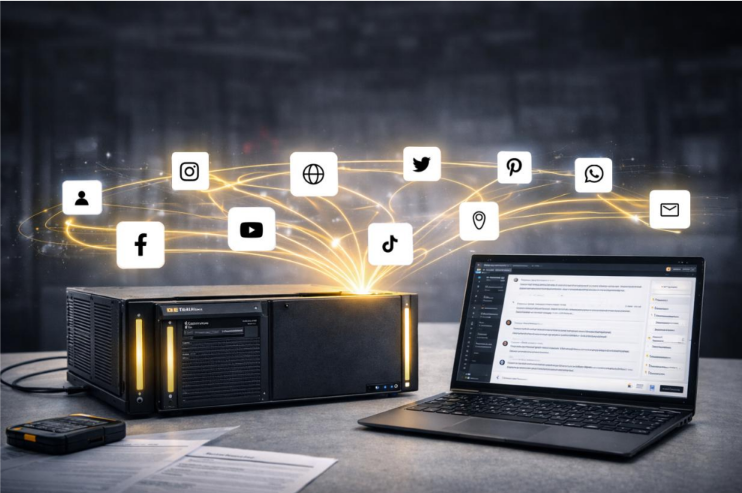
The company removed that step by shipping the hardware, installing it on site, and making ingestion drag-and-drop. Existing NAS and SAN storage, databases scattered across departments, case files, forensic reports, even handwritten documents: the platform takes them as they are, structured or not, and processes text, images and video. No data scientists are needed. Anyone on the team can load a source, and within twenty minutes analysts are querying it.
Currently, to get a database into a fusion system, you need to call the provider and send them a snippet of your data. However, it should be done in one click. The hardware is shipped, the client drags and drops, and within twenty minutes they are already working with their data instead of waiting a year for the ingestion.
The platform is model-agnostic. Clients choose which AI models to run for a given mission, swap them as better ones appear, and can train models on their own internal data. Models and data stay under the client’s ownership, on the client’s hardware, and the client’s own staff run the system day to day, with the company providing training, updates and support.
Forensics beyond keywords
Most forensic analysis still runs on keyword search, which assumes the investigator already knows which words a suspect used. They rarely do. This system’s forensic tools read the whole body of evidence instead: an investigator loads a terabyte of forensic data and the platform scans all of it, text, images, video and documents, and surfaces the anomalies, connections and timelines that point to suspicious activity, whether or not anyone thought to search for them.
Every finding stays linked to the record it came from. The investigator can open the underlying evidence, see exactly how a conclusion was reached and take that chain into court. For law enforcement, that traceability is what turns a lead into evidence.
Where open-source intelligence is needed, external OSINT feeds connect through a one-way link, so the sensitive environment gains outside data without being exposed to a conventional internet connection.
In the field
The platform is deployed with intelligence organisations in Southeast Asia and forensic departments across Africa. In Israel, they are working with the IDF under the INNOFENSE program run by iHLS with the Israel Ministry of Defense.
Deployments scale from a single tactical unit to agency-wide and national systems and data centres.
The products
Three applications sit under the same umbrella. Fusion AI combines multiple data sources into a single intelligence picture, Forensics Triage AI Centre handle large volumes of forensic evidence and OSINT Hub lets an organization replace or combine open-source providers without rebuilding the system each time.
The company
The company is revenue-funded. It has taken no outside investment, which means no foreign capital and a roadmap set by customer requirements rather than by investors. The company operates through a UK entity, with a team of 15 across Europe.
David Pinto, Founder and CEO, has 15 years in data fusion and digital forensics, in the intelligence space including senior roles at Intelligence providers, and holds degrees from Imperial College London, Tel Aviv University and Harvard. Dr. Anca Goron, Co-Founder and Chief Scientific Data Officer, leads the company’s AI research in machine learning and language models. Baram Oz-Gal, Co-Founder and CTO, leads platform and systems engineering and holds an MSc in software architecture.