

This post is also available in:
 עברית (Hebrew)
One of the persistent limitations of robotic manipulation is reach. Even highly dexterous robotic arms are constrained by their fixed mounting points, forcing complex repositioning or additional hardware when objects lie just outside their workspace. In cluttered or confined environments, this restriction can slow operations and increase system complexity.
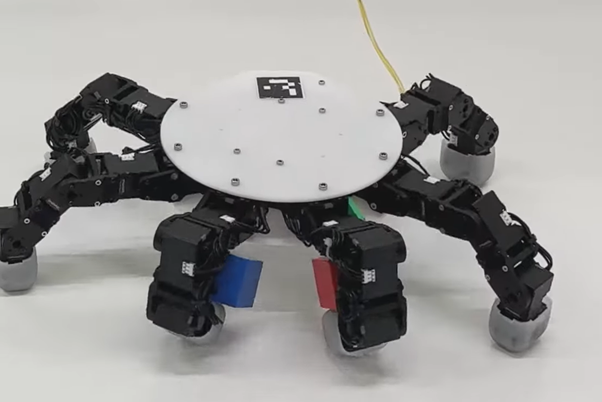
A new robotic hand concept offers a different solution by separating manipulation from the arm itself. Engineers have developed a multi-fingered robotic hand that can detach from its base, move independently across surfaces, grasp objects, and then return to reattach. Instead of extending the arm’s reach, the hand becomes a mobile manipulator in its own right.
Once released, the hand uses its fingers as legs, crawling across flat or uneven surfaces. Some fingers provide locomotion while others secure objects, allowing the system to pick up multiple items sequentially without stopping. This dual use of the fingers—switching between grasping and movement—removes the need for wheels or additional actuators dedicated solely to mobility.
According to Interesting Engineering, the key to this capability lies in the hand’s fully symmetrical design. Unlike human hands, which are asymmetric and rely on a single thumb, this structure allows fingers on opposing sides to act as interchangeable grasping pairs. As a result, the hand can approach and secure objects from any direction without reorientation. The symmetry also simplifies planning, reducing the number of movements needed to grasp, carry, and reposition items.
Each finger has four degrees of freedom and can bend in both directions, supporting both stable gaits and adaptable grasps. The final configuration was determined through a combined mechanical and algorithmic design process. Engineers balanced finger number, length, and placement against actuator limits, torque requirements, and weight. Too many fingers improved grasping but reduced crawling efficiency, so optimization tools were used to find effective tradeoffs.
Control software plays a central role. Grasping relies on a library of precomputed, collision-free poses, while movement is coordinated using pattern generators that synchronize finger motions during crawling. Planning algorithms manage docking, obstacle avoidance, and reattachment to the arm.
Beyond research labs, the concept has clear relevance for defense and homeland security applications. A mobile robotic hand could retrieve objects in confined spaces, inspect damaged infrastructure, or operate inside collapsed structures where larger robots cannot enter. In hazardous environments, the ability to detach, explore, and return reduces risk to personnel while expanding operational reach.
By combining mobility and dexterity in a single, compact mechanism, the design challenges conventional assumptions about how robotic manipulators should work—and where they can go.
The research was published here.























