

This post is also available in:
 עברית (Hebrew)
Defending large ocean areas has become increasingly difficult as navies invest in long-range missiles, swarming drones, and fast-moving vessels. Traditional ship-based weapons face two core challenges: magazine limits and the rising cost of intercepting mass salvos. Japan is now testing a system designed to address both problems — a ship-mounted hypersonic railgun capable of firing electrically propelled projectiles at extreme speeds.
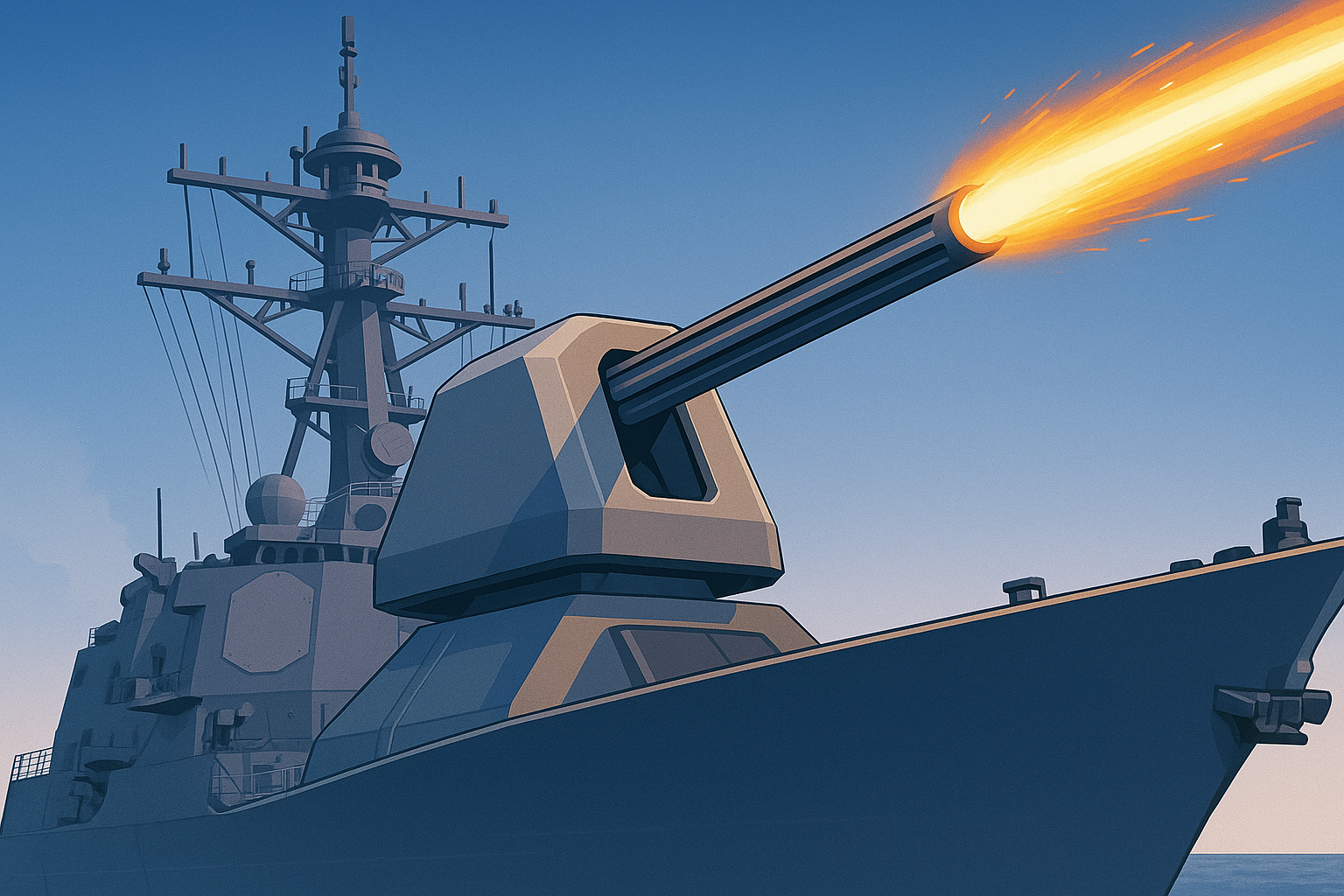
During recent demonstrations, Japan’s Acquisition, Technology and Logistics Agency (ATLA) revealed footage and data from trials conducted aboard the JS Asuka. The railgun prototype fired multiple projectiles at a moving target ship under tow, showing stable operation at sea and successful impact at significant distances. Sensors, high-speed cameras, and onboard instrumentation captured flight data to measure velocity, trajectory, and engagement range.
According to Interesting Engineering, the tests highlighted two major technical achievements: projectile speeds reaching Mach 6 and a barrel capable of more than 200 shots, a milestone given the durability challenges that plagued earlier railgun programs worldwide. Support systems such as capacitor banks still occupy substantial deck space, signalling the engineering effort ahead to reduce the weapon’s footprint.
Japan’s interest is shaped directly by the threat environment. The country faces growing pressure from China’s rapidly expanding naval fleet, which relies heavily on long-range missiles and saturation attacks to keep opposing ships at a distance. A hypersonic railgun offers an alternative response. Each shot uses only electricity and a metal round, costing a fraction of an interceptor missile. In theory, a destroyer equipped with such a system could sustain long defensive engagements without exhausting missile stores — a critical advantage in high-intensity scenarios.
Beyond intercepting threats, a railgun could serve in roles ranging from anti-ship engagements to coastal defense. ATLA’s development roadmap includes land-based variants mounted on trucks, creating mobile batteries capable of forming protective zones around key islands or maritime chokepoints. These concepts mirror China’s own anti-access strategies and signal Japan’s intent to reshape deterrence in the region.
Significant technical hurdles remain, including power generation, cooling, and miniaturizing the container-sized energy modules. Yet Japan’s visible progress — especially compared to stalled programs elsewhere — suggests the weapon is moving from theory toward practical deployment.
While years away from operational service, Japan’s railgun effort is emerging as a central element in its strategy to counter modern naval threats and strengthen defense resilience across the western Pacific.























