This post is also available in:
 עברית (Hebrew)
Timlul is a graduate of the INNOFENSE Innovation Center operated by iHLS in collaboration with IMoD. This unique acceleration program removes entrance barriers to the technological ecosystem, turning startups into mature, leading companies while connecting them with relevant investors, which is designed to strengthen the links between the civilian and defense markets via the collaborative development of the technologies, thus advancing and improving their integration in both markets.
Organizations that assess and screen people face a fundamental challenge of scale and consistency. Whether in the military, human resources, academic research, or speech therapy, much of the relevant information comes through language: interviews, questionnaires, recordings, résumés, and conversations. Yet in many cases, this material is still analyzed by people, who struggle to thoroughly review thousands of documents or hundreds of hours of recordings, can experience fatigue, and may be influenced by bias. Moreover, valuable information does not always lie solely in what a person says, but also in how they say it.
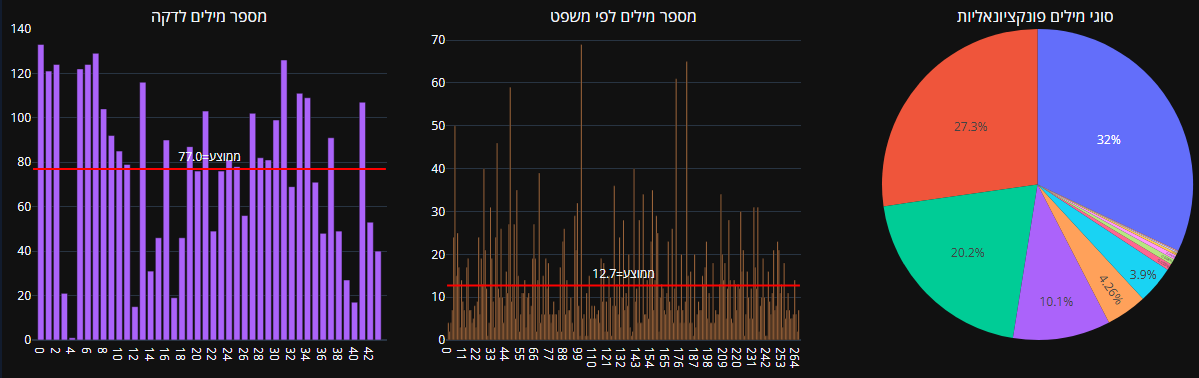
Founded in 2023, Timlul develops decision-support systems based on natural language processing (NLP), speech recognition, and the analysis of voice and textual data. Rather than offering a single standardized product, the company builds each project around the organization’s specific challenge and data, adapting its engine to the relevant assessment methods, historical information, and datasets. The system transcribes and analyzes the material, extracts measurable parameters, and combines algorithms, language models, and statistical analysis to generate scores or insights designed to assist human decision-makers.
One application of the technology is in the defense sector, where it serves as a decision-support tool for analyzing interviews and questionnaires. The system examines speech and language patterns to identify characteristics, anomalies, and risk factors that may be relevant to assessing individuals and determining their suitability for different roles. The goal is not to replace the professional making the final decision, but to provide an additional, consistent layer of analysis capable of processing large volumes of information while reducing reliance on human assessment alone, which is usually based on numerical assessments without in-depth language processing.
The same engine allows the company to operate well beyond the defense sector. In speech therapy, for example, vocal characteristics such as speech patterns, sequences, and segments can be analyzed to help identify pronunciation difficulties. In human resources, the technology can analyze résumés and job interviews, while academic researchers can rapidly process large collections of interviews and conduct qualitative studies on an unlimited amount of content. In one proof of concept for research examining Israeli ethos following October 7th, a task estimated to require approximately 331 hours of human work was completed by the Timlul.ai system in less than seven hours. The system is also multilingual and its solutions can be implemented globally.
The technological approach is largely built around automation. Verbal and numerical assessment methods are translated into algorithms, combined with an LLM, and then subjected to statistical weighting. According to the company, in its defense-related work, the system achieved twice the predictive capability for applicants’ riskiness and resilience using existing data and methods, with the aim of quadrupling the predictability. The company also says that results can be broken down into different personality-related metrics, making it possible not only to flag an anomaly but also to understand which characteristics contributed to the assessment.
The company has not raised external funding to date and operates with private funding of the initiative as Bootsrapping. Dr. Zvi Tubul-Lavy leads the company’s research and development, supported by a part-time backend developer. The small human team, however, is part of the operating model: according to the company, it works alongside more than 30 AI agents, which perform a significant share of the workload and allow operations to scale without increasing headcount at the same rate.
The idea itself emerged when Dr. Tubul-Lavy watched his mother, a speech therapist (Dr. Gila Tubul-Lavy), working with headphones and manually transcribing material, and began developing an automatic process. What started as a transcription tool and developed into a biometric data system with insights: if a machine can already understand the words, why not use it to help understand what can be learned from them?