This post is also available in:
 עברית (Hebrew)
Small commercial drones are increasingly becoming a security problem for military forces and critical facilities. Detecting an unauthorized UAV is only part of the challenge: security teams must determine where it is flying, identify its operator and decide how to stop it before it reaches a protected area. Using separate systems for each stage can add cost and slow the response.
Nigeria is testing a locally developed counter-unmanned aerial system designed to bring those functions together. Developed by Babasky Technologies, the electronic warfare platform recently underwent a demonstration for Nigerian military and intelligence officials, where it was used to detect, locate and disrupt small and medium multirotor drones.
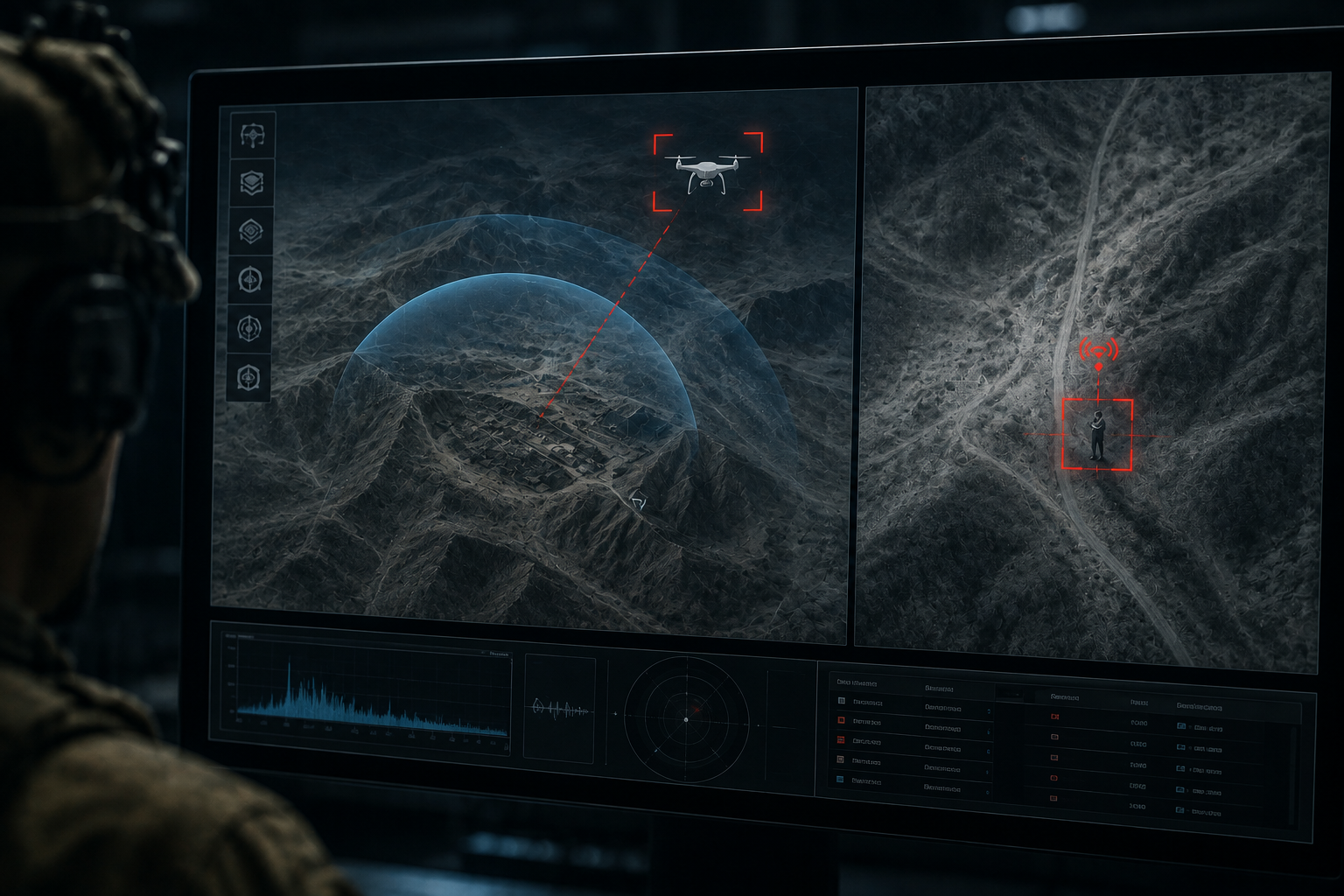
According to NextGenDefense, the system can detect UAVs at distances of up to 8 kilometers. It also attempts to locate the drone operator on the ground, potentially giving security personnel information needed for investigation or follow-on action rather than concentrating exclusively on the aircraft itself.
The platform uses software to create a digital picture of the protected airspace. Operators can establish virtual no-fly zones around military installations, government facilities or other sensitive locations. When an unauthorized drone crosses one of these boundaries, the system can identify the intrusion and initiate a response.
For the defeat stage, the C-UAS uses directional radio-frequency jamming. Rather than broadcasting interference equally in every direction, directional jamming concentrates RF energy toward the target. The objective is to interfere with the communications and telemetry links connecting the drone to its controller.
What happens next depends on the UAV and its programming. A drone that loses its control link could hover, return home or initiate an automated landing procedure. The company reported that its system can potentially force affected aircraft into a landing mode.
The demonstration comes as inexpensive unmanned systems become increasingly accessible to armed groups and other non-state actors. Commercial multirotors can be adapted for reconnaissance and other hostile activities, creating a demand for defenses that do not depend on expensive missiles or other kinetic interceptors.
An integrated electronic warfare approach could also simplify the counter-drone kill chain, which is the sequence from detecting a threat to identifying, tracking and ultimately defeating it. Bringing those capabilities into one architecture may reduce the need to manually coordinate several independent systems during a fast-moving incident.
The technology is being positioned as a locally produced alternative to imported counter-drone equipment. Publicly available information does not yet establish how the system performs against autonomous drones that do not require an active control link, or against UAVs designed to resist electronic warfare.
Still, the demonstration reflects a broader shift in counter-UAS development: moving beyond standalone jammers toward integrated systems capable of finding a drone, understanding where it came from and providing operators with an immediate electronic response.