This post is also available in:
 עברית (Hebrew)
Small, commercially available drones have become a persistent battlefield problem. Easy to acquire and modify, they are now widely used for reconnaissance, targeting, and direct attack. For ground forces, especially in dense or civilian-heavy environments, defeating these threats is difficult. Kinetic interceptors risk collateral damage, while electronic warfare is not always effective against autonomous or hardened systems. This has driven demand for counter-drone solutions that are precise, fast to deploy, and safe to use close to friendly forces.
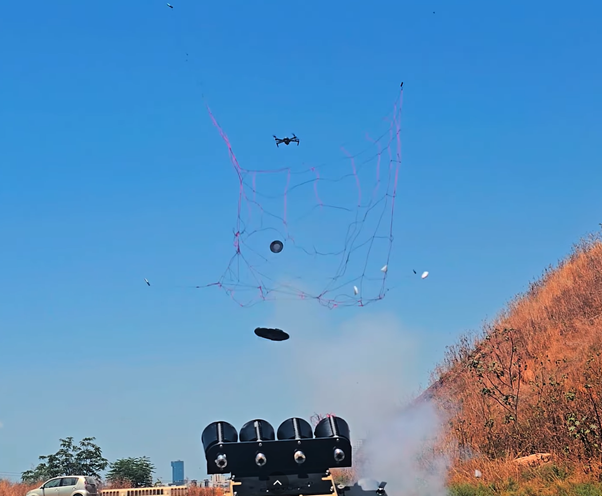
One such approach has now moved from trials into operational use. An Israeli defense user has placed its first contract for DefendAir, a counter-unmanned aerial system designed to physically capture hostile drones rather than destroy them. The system neutralizes aerial threats by firing a net that entangles the target, causing it to lose lift and fall in a controlled manner. By avoiding explosive effects, the method is intended to minimize unintended damage on the ground.
According to the Defense Post, the system is built around flexibility. The interception mechanism can be deployed from several platforms, depending on the operational scenario. It can be mounted on a dedicated interceptor drone, installed on a fixed or mobile turret, or operated as a handheld launcher by ground troops. Engagement ranges vary by configuration, from just a few meters for close protection up to roughly 100 meters for wider-area defense. Net size can also be tailored, allowing operators to address anything from small quadcopters to larger improvised aerial platforms.
Beyond the core interception capability, the system can be expanded with additional sensors and connectivity. Optional radar inputs, command-and-control links, and radio-frequency components allow it to integrate into broader air-defense or base-protection networks. This modularity supports rapid adaptation as drone tactics evolve, without requiring a complete system redesign.
From a defense perspective, the appeal lies in how the system fits modern operational constraints. Ground forces increasingly operate in environments where civilian presence, friendly assets, and sensitive infrastructure limit the use of hard-kill countermeasures. A net-based interceptor offers a way to defeat drones used for surveillance or attack while preserving evidence and reducing escalation risks.
The contract includes not only delivery of multiple systems but also integration and training, enabling rapid operational deployment. It reflects a wider shift toward layered counter-UAS defenses that combine detection, command-and-control, and low-collateral interception. As drones continue to shape contemporary conflicts, solutions that emphasize precision and adaptability are becoming an essential part of force protection.