

This post is also available in:
 עברית (Hebrew)
Most robots are designed around familiar biological forms. Engineers often model machines after humans, dogs, insects, or other animals, relying on centralized software and coordinated control systems to manage movement. But these designs can struggle in unpredictable terrain where balance, orientation, or mechanical failures quickly disrupt performance.
Researchers have now demonstrated a radically different robotic concept built around a mathematical principle called “dynamic isotropy”. Instead of optimizing the robot’s appearance, the design focuses on how uniformly it can move and accelerate in every direction. The result is a 20-legged robot that behaves less like a conventional machine and more like a self-stabilizing mobile structure capable of adapting continuously to its surroundings.
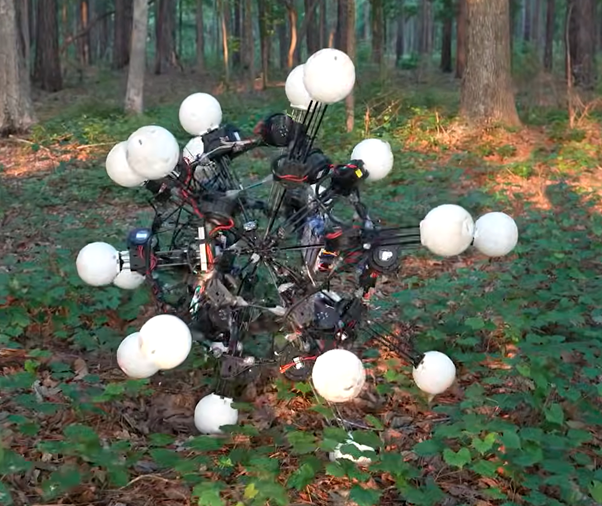
The robot, called Argus, has no defined front or rear. According to TechXplore, its body consists of 20 telescoping legs extending outward from a central core, with each leg equipped with a depth camera. The legs are arranged geometrically around a dodecahedron structure, allowing the robot to distribute movement forces and sensing capability evenly across all directions.
Each leg can extend, retract, and push independently, enabling the robot to roll, brace, climb, and reorient itself without needing to rotate its body toward a target direction first. According to the researchers, this high degree of “dynamic symmetry” allows the robot to maintain mobility even after significant impacts or damage.
In testing, the robot crossed sand, wet surfaces, foliage, and uneven terrain while remaining stable after collisions and external pushes. It also continued operating even after three legs were disabled. One experiment demonstrated vertical climbing between parallel walls by alternately extending and bracing different sets of legs against surrounding surfaces.
The robot’s behavior is driven by whole-body coordination rather than centralized directional control. Because movement capability is nearly uniform in every direction, the system avoids many of the orientation constraints found in traditional robots.
From a defense and security perspective, dynamically symmetric robots could support operations in cluttered or hazardous terrain where conventional wheeled or legged systems struggle. Their ability to tolerate damage and continue functioning without relying on a single movement direction may be useful for reconnaissance, logistics, or exploration in unstable environments.
The broader research also introduces a new framework for designing robots mathematically around mobility and resilience rather than biological imitation alone.
The research was published here.























