

This post is also available in:
 עברית (Hebrew)
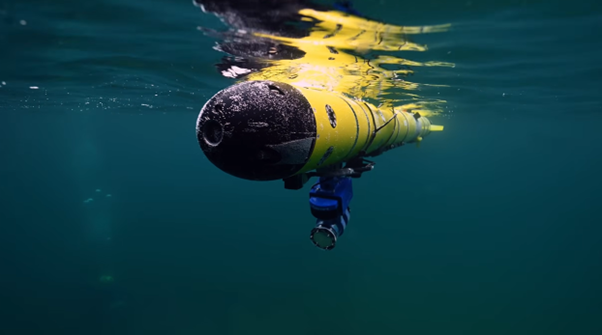
Underwater operations present a persistent challenge for both humans and machines. Visibility is often limited, communication is constrained, and navigation can quickly become uncertain. Autonomous underwater vehicles (AUVs) can process data rapidly, but they struggle with complex physical tasks. Human divers, on the other hand, can adapt and make nuanced decisions, but lack the same level of situational awareness and data processing.
A new set of algorithms, developed by MIT, aims to bridge this gap by enabling closer coordination between divers and autonomous systems. Instead of operating independently, the system allows both to function as a connected team, sharing information and adjusting actions in real time.
According to NextGenDefense, at the core of the approach is a navigation algorithm that continuously estimates the relative position of both the diver and the AUV. By relying on simple distance measurements taken at intervals, the system can track movement over time and maintain alignment between the two. This allows the robot to follow, assist, or reposition itself based on the diver’s actions, even in low-visibility conditions.
In parallel, a perception algorithm processes data from onboard sensors, including optical and sonar inputs. When the system encounters uncertainty, such as an object it cannot confidently identify, it flags the issue and requests human input. The diver can then confirm or correct the classification, improving accuracy on the spot. This creates a feedback loop where machine sensing and human judgment reinforce each other.
One of the more notable aspects is how the system handles ambiguity. Instead of forcing a decision, it highlights uncertainty and incorporates human input into the process. Over time, this can also improve the system’s ability to classify similar objects in future missions.
From a defense and homeland security perspective, coordinated human-robot operations underwater are particularly relevant for tasks such as infrastructure inspection, mine countermeasures, and search operations. Combining autonomous sensing with human decision-making can improve efficiency while reducing the cognitive and physical load on divers.
As underwater environments remain one of the most complex operational domains, technologies that enable real-time collaboration between humans and machines may play a key role in expanding what can be achieved below the surface.























