This post is also available in:
 עברית (Hebrew)
Amphibious assaults place unique demands on armored vehicles. Platforms must survive open-water transit, land directly onto hostile shores, and then continue operating inland against a wide range of threats. For decades, many forces relied on legacy systems that struggled to balance protection, mobility, and firepower, especially as modern anti-armor weapons and precision fires became more common.
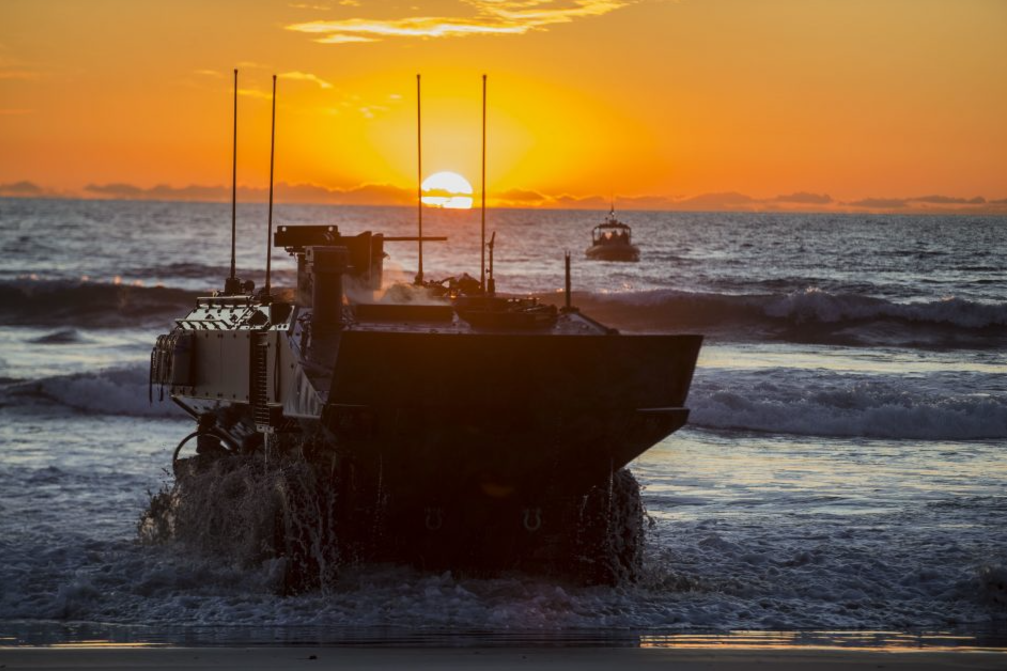
A new generation of amphibious combat vehicles (ACV-30) is designed to address those gaps. The latest variant entering production combines ship-to-shore capability with improved protection and heavier armament, allowing troops to engage targets at greater distances once ashore. Built as a true 8×8 platform, the vehicle is designed to transition seamlessly from surf to land without compromising mobility or crew safety.
According to Interesting Engineering, at the core of the design is a focus on survivability and adaptability. The vehicle features a blast-resistant hull and energy-absorbing seating intended to protect occupants from mines, improvised explosive devices, kinetic threats, and overhead attacks. An automatic fire-suppression system further reduces risk in combat conditions. Full-time all-wheel drive, delivered through a proven drivetrain, provides traction in loose sand, mud, urban terrain, and shallow water, allowing the vehicle to maneuver where older platforms struggled.
The platform is fielded in several configurations to support different mission roles. Personnel variants are designed to transport a full infantry squad along with a three-person crew, while command variants provide multiple workstations for managing communications and situational awareness during operations. Recovery variants add cranes and repair equipment, enabling field-level maintenance and vehicle recovery close to the front line, reducing reliance on rear-area support.
One of the most notable developments is the integration of a remotely operated turret system on certain models. This adds medium-caliber firepower, allowing the vehicle to engage threats beyond small-arms range while keeping the crew protected inside the hull. The modular approach also allows future upgrades as mission requirements evolve.
From a defense and homeland security perspective, such vehicles play a critical role in expeditionary operations. They enable rapid deployment from sea to land, support coastal maneuver, and provide protected mobility in contested environments. Beyond traditional amphibious assaults, they are suited for crisis response, littoral security, and operations in areas with limited port infrastructure.
As amphibious forces adapt to modern threats, platforms that combine protection, mobility, and scalable firepower are becoming central to how troops move from ship to shore and operate once they arrive.