This post is also available in:
 עברית (Hebrew)
Armored vehicles increasingly need to defend against threats coming from more than one direction. Crews may have to engage ground targets while simultaneously watching for small drones overhead, all without exposing themselves outside the vehicle. At the same time, information detected by one vehicle needs to reach others quickly enough to be useful.
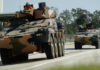
Two new AMPV 30 concept vehicles are being tested by the U.S. Army with a combination of heavier firepower, counter-drone technology and networked targeting designed around those requirements.
Built by BAE Systems, the prototypes use the existing Armored Multi-Purpose Vehicle chassis rather than an entirely new vehicle. Both are fitted with Kongsberg’s Medium Caliber Turret, a remotely operated 30mm weapon station that allows the crew to engage targets while remaining inside the armored hull.
The turret is already in production for the Marine Corps’ Amphibious Combat Vehicle. Its integration onto AMPV demonstrates how the platform could be adapted into an infantry fighting vehicle configuration.
Firepower, however, is only one part of the upgrade.
According to Interesting Engineering, the prototypes include counter-unmanned aircraft system capabilities intended to help crews respond to drones. Detailed specifications of the counter-UAS equipment have not been disclosed, but its inclusion reflects the growing need for armored formations to protect themselves from small aerial threats rather than depending entirely on separate air-defense units.
Another addition is a cross-platform target handoff system. This allows connected vehicles to exchange targeting information, so a threat detected by one platform can be passed to another. Instead of every crew independently finding the same target, vehicles can contribute to a shared picture and coordinate which platform responds.
A 360-degree camera system provides another layer of situational awareness. Crews can observe the area surrounding the vehicle without opening hatches or leaving the protection of the armor, helping them monitor nearby threats while remaining under cover.
The design is built around modularity. The company’s common top plate allows different turrets and mission equipment to be installed on the AMPV chassis without redesigning the underlying vehicle. According to the company, the platform can accommodate more than 30 turret systems.
That approach also helped accelerate development. The two prototypes were completed in six months using $17 million in company research-and-development funding.
The vehicles were delivered in April for the Army’s Transformation in Contact 2.0 initiative and have since undergone soldier evaluations, including live-fire testing.
The concept reflects how the role of an armored vehicle is expanding. Carrying a larger cannon remains important, but modern survivability increasingly depends on seeing drones, sharing targets and understanding what is happening around the vehicle before the crew ever needs to leave its armor.