This post is also available in:
 עברית (Hebrew)
Underwater environments are notoriously demanding for electronic systems. Sensors used by divers and underwater robots must withstand pressure, moisture and constant mechanical stress while continuing to provide reliable feedback. If a sensor is punctured or torn, it often loses functionality immediately, and repairs usually require returning the equipment to the surface. That limitation reduces mission endurance and can create safety risks during underwater operations.
Researchers at the National University of Singapore have developed an electronic skin designed to address these challenges. Called the Self-Healing Magnetoelectric Sensory System (SMES), the technology combines touch sensing, proximity detection, damage monitoring and self-repair in a single flexible device that continues operating both in air and underwater.
Inspired by biological skin, the system is built from multiple stretchable layers made from a self-healing elastomer embedded with liquid-metal conductors. The upper layer continuously monitors the condition of the sensor itself. When it is punctured or cut, its electrical resistance changes sharply, allowing the system to recognize damage in much the same way human skin detects pain. Thanks to reversible molecular bonds within the material, damaged sections reconnect when brought back into contact, enabling the sensor to restore its structure and functionality without replacing any components.
Unlike many electronic skins, SMES also generates its own electrical signals. The device uses electromagnetic induction, placing a small magnet next to a liquid-metal coil. When pressure is applied or an object moves nearby, the magnet shifts relative to the coil, producing a voltage that the system uses to detect both touch and nearby objects. Because the sensing mechanism creates its own electrical output, the device does not require an external power supply, an important advantage for underwater applications where battery replacement is difficult.
According to TechXplore, laboratory testing showed that the sensor responds in approximately 41 milliseconds and maintained stable performance after 10,000 operating cycles. The researchers also reported that its sensing capability remained consistent after ten days of immersion in water, including simulated seawater. Following punctures, the sensor recovered within seconds, while more severe cuts regained functionality after a longer healing period.
To demonstrate practical applications, the team integrated the technology into a smart diving glove that converts hand gestures into wireless commands such as “Help,” “Going up” and “Holding.” The glove also alerts the wearer when significant damage is detected. In a second demonstration, the electronic skin was installed on an underwater robotic hand that successfully grasped and transported objects while detecting and recovering from puncture damage caused by sharp shells.
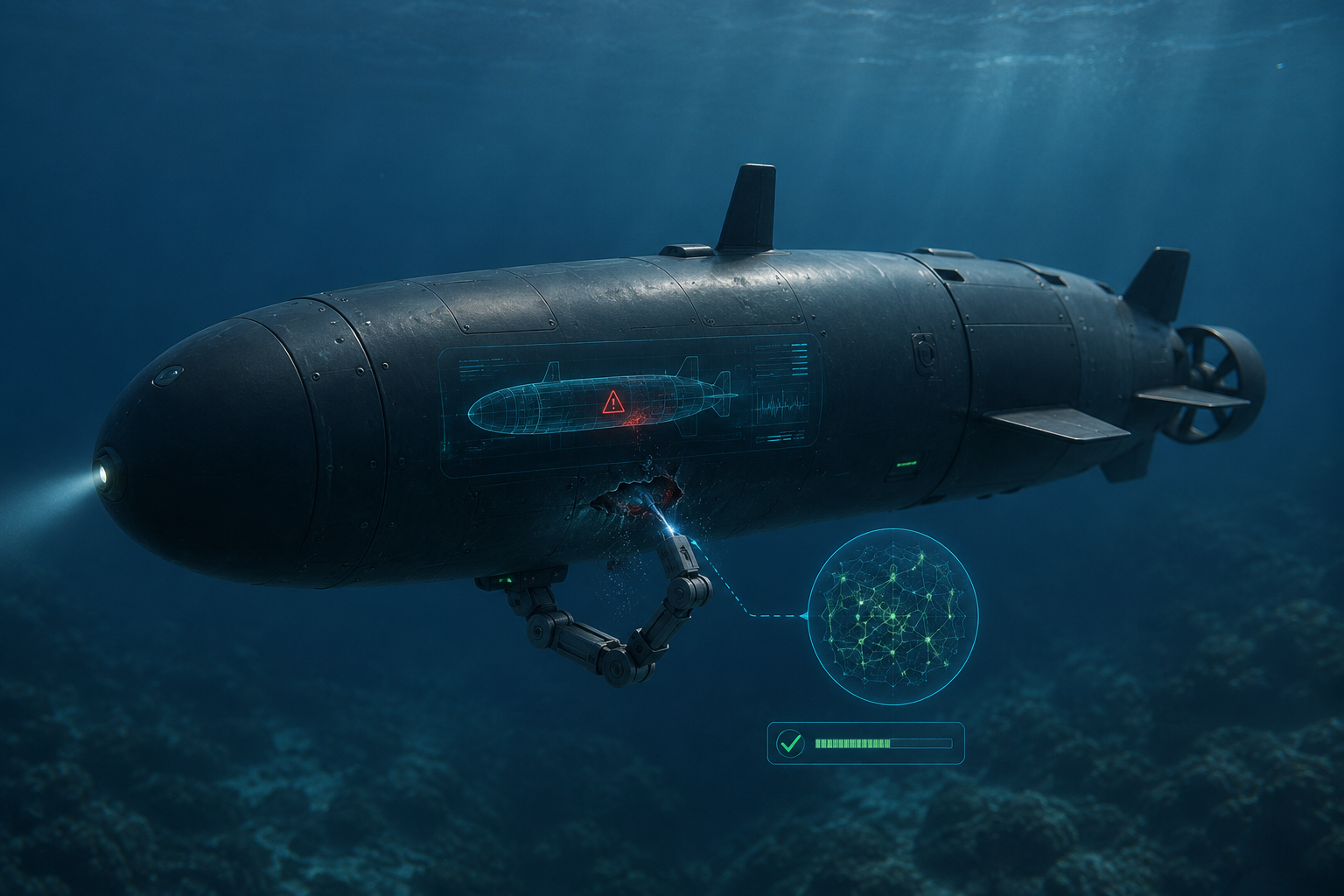
Beyond scientific research, self-healing electronic skin could have significant defense and homeland security applications. Underwater drones used for mine countermeasures, infrastructure inspection, harbor security and reconnaissance often operate for extended periods without human access. Sensors capable of detecting their own damage, continuing to function and repairing themselves could improve mission reliability while reducing maintenance requirements. The same technology could also enhance diver equipment, underwater manipulators and future soft robotic systems designed to operate in unpredictable maritime environments.
The research was published here.