

This post is also available in:
 עברית (Hebrew)
Modern military operations generate enormous amounts of information. Intelligence reports, satellite imagery, drone feeds, logistics updates and battlefield reports must all be analyzed before commanders can decide how to deploy forces. As conflicts become faster and more complex, traditional planning processes that can take hours, or even days, are becoming increasingly difficult to keep pace with.
To address this challenge, the US Army is evaluating an experimental artificial intelligence platform designed to accelerate operational planning without removing humans from the decision-making process. Known as the Course of Action Generative Pre-trained Transformer (COA-GPT), the system is being tested during Project Convergence Capstone 6, the US Army’s large-scale experimentation exercise, to determine how AI can support battlefield planning under realistic operational conditions.
Rather than making decisions independently, the platform functions as a planning assistant. It combines generative AI with established military doctrine and operational knowledge to rapidly generate multiple courses of action—alternative plans for accomplishing a mission. Commanders can then compare these options, evaluate their strengths and weaknesses, and modify them before selecting the most appropriate approach.
According to Interesting Engineering, the goal is to reduce the time required to develop operational plans from hours or days to seconds while ensuring that military personnel remain responsible for final decisions. The platform has been designed to fit into existing planning workflows instead of replacing them, allowing commanders to make use of AI without fundamentally changing how planning teams operate.
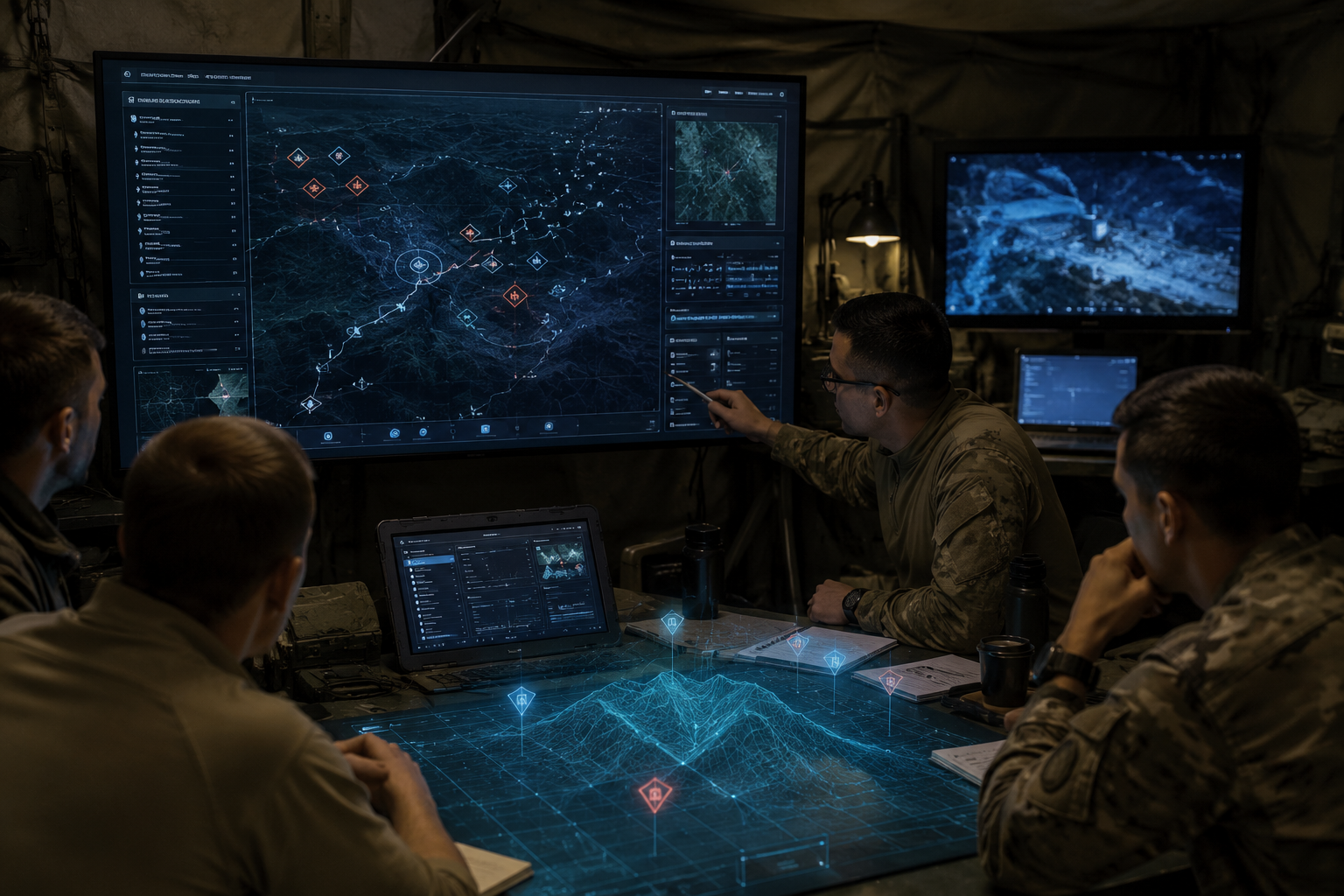
One of the system’s distinguishing features is its graphical interface, developed in collaboration with Hyssos Tech. Instead of relying solely on text prompts, commanders can interact with the AI through shared maps and visual planning tools. This allows military leaders to express their intent more naturally while helping AI-enabled systems better interpret operational objectives and coordinate with both human teams and autonomous platforms.
The software also uses a plug-and-play architecture, allowing individual AI components to be replaced or upgraded without redesigning the entire platform. This modular approach enables researchers to evaluate new algorithms and capabilities more quickly as AI technology continues to evolve.
AI-assisted planning is becoming increasingly important for defense organizations because future operations are expected to involve large numbers of autonomous systems operating alongside human forces. Commanders may eventually need to coordinate drones, robotic vehicles, sensors and conventional units simultaneously while adapting to rapidly changing battlefield conditions. Systems such as this could help manage that complexity by presenting commanders with multiple planning options in real time while leaving strategic decisions in human hands.
Following the current evaluation, researchers plan to refine the platform using feedback from soldiers and continue exploring how generative AI can improve military planning, decision support and human-machine collaboration in future operations.























