This post is also available in:
 עברית (Hebrew)
Providing advanced medical care in remote or high-risk environments remains a major challenge. On the battlefield, the time between injury and treatment is often critical, yet evacuation may be delayed due to ongoing threats, terrain, or distance. In such conditions, even basic stabilization can be difficult, let alone complex surgical procedures.
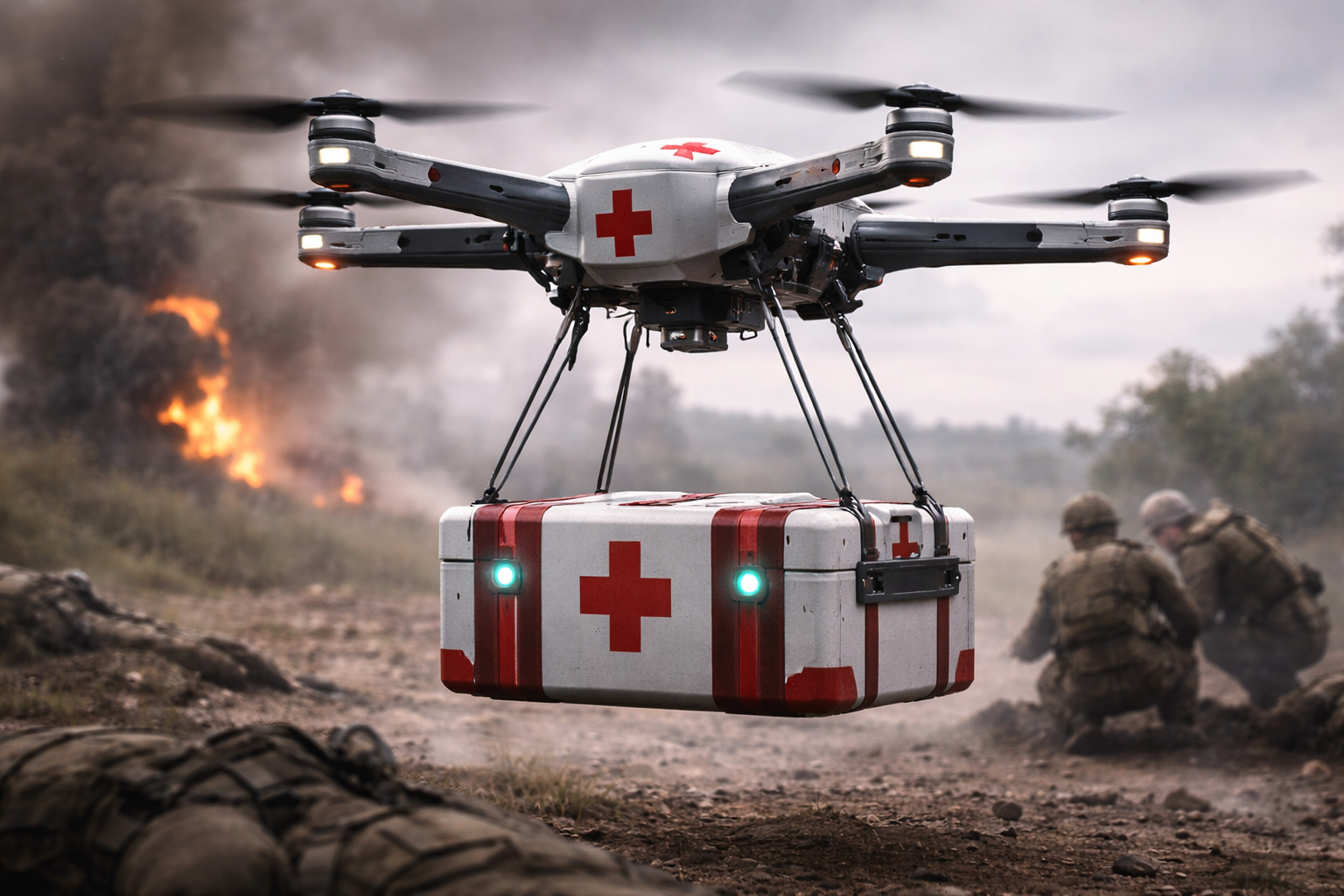
A new drone-based concept (called SSI Vimana) aims to bridge this gap by bringing remote surgical capability directly to the point of injury. Instead of transporting the patient to a medical facility, the system delivers a compact robotic surgery platform to the casualty and enables a specialist to operate from afar. The drone is designed to land near the injured person and deploy robotic arms capable of performing essential procedures.
The system focuses on immediate life-saving interventions. These include controlling bleeding, repairing wounds, relieving chest pressure, and removing shrapnel. Using miniature surgical tools, the robotic arms can carry out precise actions while being remotely controlled by a trained surgeon. This approach is intended to stabilize patients until evacuation becomes possible.
According to Interesting Engineering, at the core of the platform is a lightweight adaptation of an existing robotic surgery system, redesigned for mobility and rapid deployment. The drone itself is GPS-guided and built for short-duration missions, with enough flight and operating time to reach the casualty and perform urgent procedures. Unlike traditional medical drones that deliver supplies, this system enables direct intervention.
Another key aspect is connectivity. Remote operation requires stable, low-latency communication between the drone and the operator. The concept also emphasizes cybersecurity, with efforts focused on ensuring that control systems remain protected against interference.
Beyond its primary role, the platform is designed with flexibility in mind. Similar capabilities could be used in civilian scenarios, such as disaster response or remote accident sites, where immediate access to specialized care is limited.
From a defense perspective, the concept reflects a broader shift in how medical support is delivered in combat zones. As operations move into more dispersed and contested environments, systems that reduce reliance on evacuation and bring care closer to the frontline could improve survival rates.
While still in early development, the idea highlights how robotics, connectivity, and unmanned systems are converging to expand the reach of medical care in challenging conditions.