

This post is also available in:
 עברית (Hebrew)
Moving heavy cargo by air without runways remains a major bottleneck for emergency response, logistics, and military operations. Helicopters can do the job, but they are costly to operate, maintenance-intensive, and not always available at short notice. Conventional multirotor drones, meanwhile, struggle to scale beyond relatively light payloads, especially when range, endurance, and portability are required at the same time.
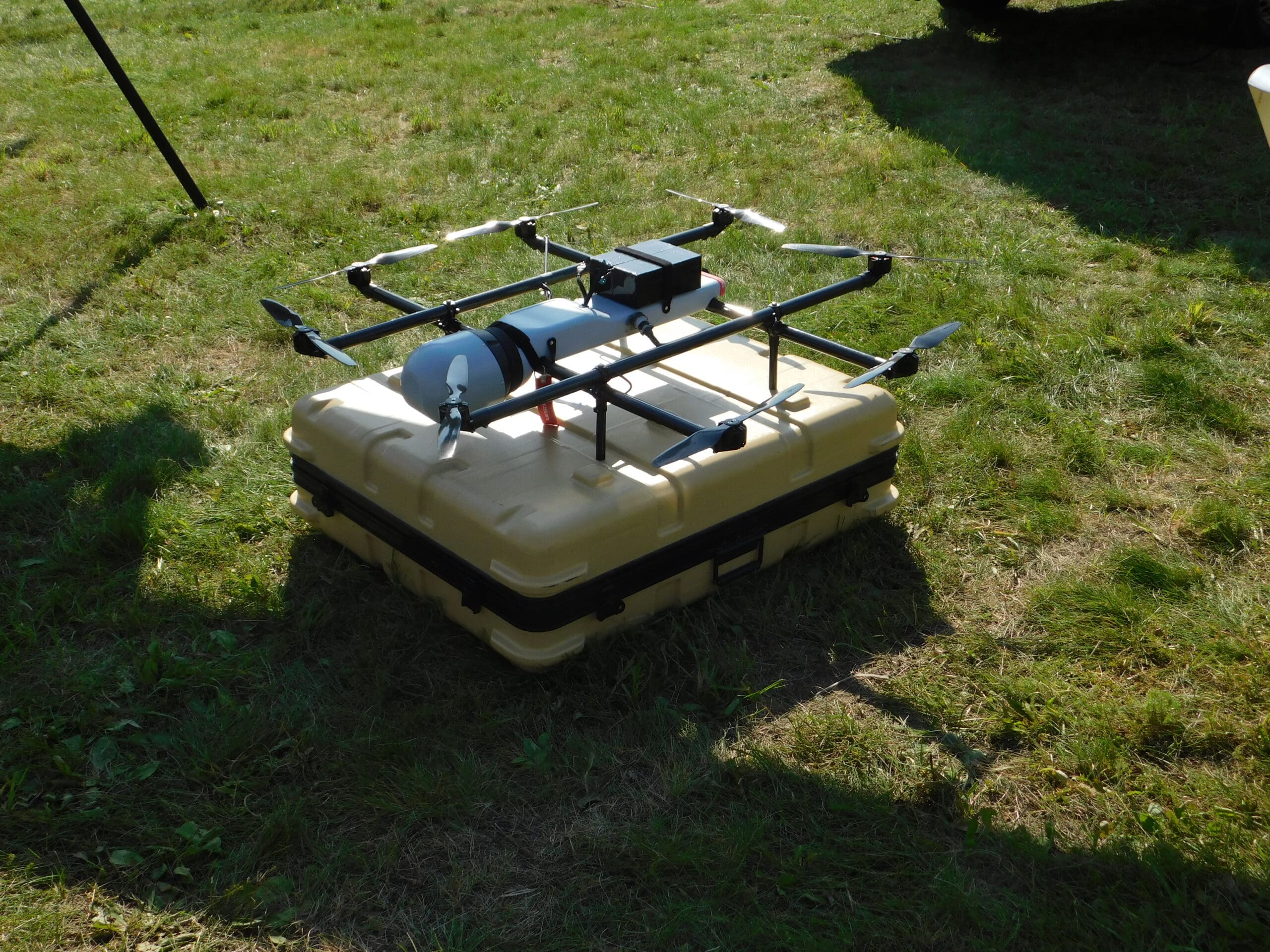
A newly flown vertical take-off and landing (VTOL) platform is designed to close that gap. The HYDRA-400 is an ultra-heavy-lift unmanned aerial vehicle built around a hybrid propulsion concept that combines electric lift rotors with micro jet turbines. This architecture allows the aircraft to lift payloads of up to 400 kilograms, while remaining compact enough to be transported on a flatbed truck and assembled in minutes at the launch site.
The hybrid design is central to how the system solves the lift problem. Electric rotors provide stable vertical take-off and landing, while the jet turbines add the thrust needed to handle heavier loads without dramatically increasing size. The aircraft can be configured as fully electric or as a hybrid using up to six jets, depending on mission requirements. This flexibility allows operators to balance payload, endurance, and energy use for different scenarios.
Initial flight testing followed an earlier ground-run campaign and focused on validating stability and control across both mechanical and electrical systems. According to Interesting Engineering, during these tests, the aircraft demonstrated reliable flight characteristics while carrying substantial loads. One configuration included the transport of a stretcher, highlighting the platform’s suitability for casualty evacuation and rescue missions where ground access is limited or unsafe.
An unmanned system that can vertically deliver heavy cargo opens new options for resupply, equipment transport, and evacuation in contested or austere environments. Unlike manned helicopters, a heavy-lift UAV can operate without exposing aircrews to risk, and its smaller footprint simplifies deployment closer to the point of need. The same characteristics also support humanitarian relief operations following natural disasters, where infrastructure damage often prevents conventional air or ground access.
Beyond lift capacity, portability is a defining feature. The ability to move the aircraft by truck and prepare it quickly for flight supports rapid redeployment and distributed operations. As testing continues, platforms in this class point toward a future where heavy aerial lift is no longer limited to large, crewed aircraft, but can be delivered by flexible, unmanned systems designed for both civilian and security missions.























