

This post is also available in:
 עברית (Hebrew)
For decades, Israel’s artillery relied on tracked systems introduced in the 1980s. While dependable, those platforms were manpower-heavy, slower to reposition, and increasingly mismatched with a battlefield that now demands rapid movement, precise coordination, and smaller crews. The challenge has been clear: how to modernize ground fire support without sacrificing range, accuracy, or survivability.
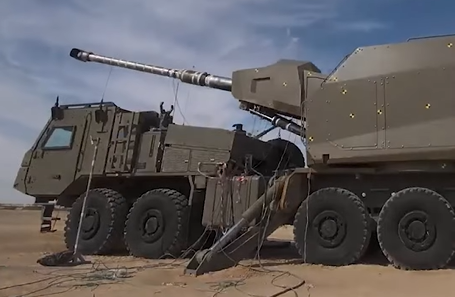
That gap is now being addressed with the induction of a new, locally manufactured, wheeled self-propelled howitzer, the SIGMA 155, known in Hebrew as Ro’em. The system represents a clean break from legacy artillery concepts. Built around a 155mm gun, it combines long-range firepower with high mobility and extensive automation, allowing it to deliver sustained, coordinated strikes while operating with far fewer soldiers.
At the heart of the system is an automated loading mechanism that replaces one of the most physically demanding roles in artillery service. Instead of manually lifting heavy shells, the gun loads itself, enabling a firing rate of up to eight rounds per minute. This automation also supports synchronized, time-on-target missions, where multiple guns fire from different locations, so shells arrive simultaneously across several objectives. The effective range reaches up to 40 kilometers, placing it firmly in the modern long-range artillery category.
The SIGMA 155 is designed for fast-moving maneuver warfare; its wheeled configuration allows quicker relocation between firing positions than tracked platforms, improving survivability against counter-fire and offering greater flexibility across varied terrain. Advanced command-and-control systems link multiple howitzers into a networked fire unit, supporting coordinated strikes over wide areas in real time.
The system’s reduced crew requirement is another defining feature. Each gun is operated by just three soldiers—a commander, a gunner, and a driver—down from seven in older platforms. This not only addresses persistent manpower shortages but also simplifies training and logistics. The design also removes physical barriers that previously limited full integration of female combat soldiers in artillery units.
Initial induction is underway, with live-fire exercises scheduled as part of the evaluation and training process. Production is continuing in parallel, with additional units set for delivery over the coming months. The first operational battalion is expected to be fielded later this year, and the transition to the new system is planned to expand steadily throughout the decade.
As artillery once again becomes central to high-intensity ground operations, the SIGMA 155 reflects a broader shift: fewer soldiers, faster movement, and precision fire integrated tightly with maneuvering forces.























