This post is also available in:
 עברית (Hebrew)
The rapid rise of small drones has created a difficult challenge for air-defense planners. Commercial quadcopters and other low-cost unmanned aircraft can be deployed in large numbers, forcing defenders to use interceptors that often cost significantly more than the targets themselves. As drone threats continue to evolve, militaries are searching for alternatives that can engage large numbers of targets without rapidly depleting missile inventories.
One technology attracting growing attention is directed energy. Instead of launching physical interceptors, these systems use concentrated energy to disable or destroy aerial threats. A recent demonstration highlighted how this approach could become part of future counter-drone defenses.
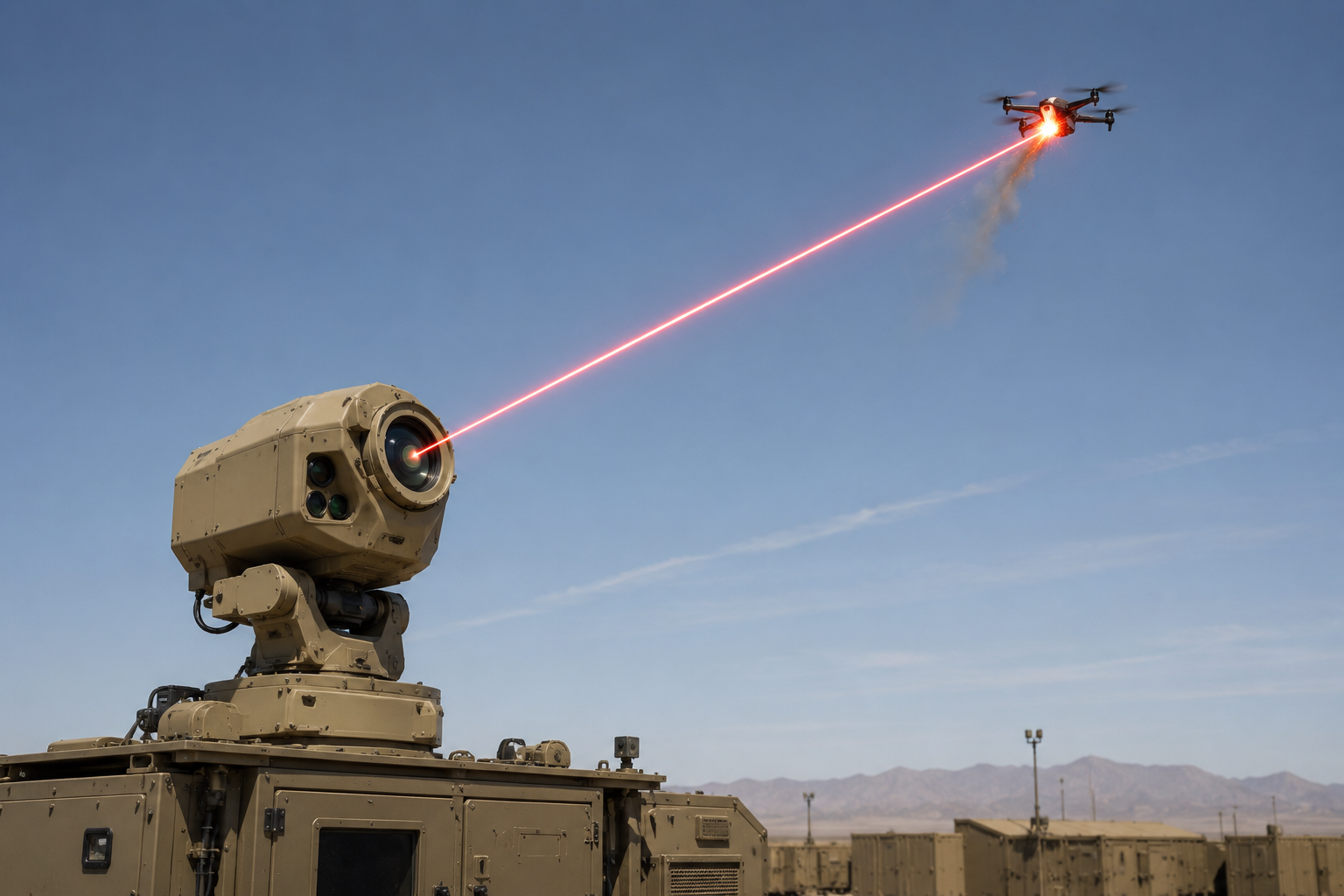
During a live evaluation, an autonomous laser weapon system (Archimedes, developed by Aurelius Systems) engaged more than 20 quadcopters as well as five military-supplied drone targets. The exercise formed part of a broader assessment involving dozens of emerging technologies being examined for future defense applications.
According to Interesting Engineering, the system is designed to detect, identify, track, and engage targets with minimal operator involvement. Using a combination of sensors and targeting software, it continuously monitors the airspace, classifies potential threats, and directs a high-energy laser onto the selected target.
Unlike missile-based defenses, which are limited by the number of interceptors carried, a laser system can continue engaging threats as long as sufficient power is available. This makes it particularly attractive against swarms or repeated drone incursions where the cost and availability of conventional munitions become important considerations.
The platform was developed to counter Group 1 and Group 2 unmanned aerial systems. These categories include small drones as well as larger platforms weighing up to approximately 600 kilograms and capable of operating at relatively high speeds.
According to the developer, the system can repeatedly engage aerial targets at distances beyond one kilometer. The architecture emphasizes low size, weight, power, and cost requirements, allowing deployment in locations where larger air-defense systems may be impractical.
From a defense perspective, directed-energy systems are increasingly viewed as an important complement to traditional air-defense networks. Lasers offer a different engagement option that can be used against low-cost aerial threats while preserving more expensive interceptors for higher-priority targets.
The recent demonstration marks another step in the broader effort to develop layered air-defense architectures capable of responding to the growing diversity and volume of drone threats appearing on modern battlefields.