This post is also available in:
 עברית (Hebrew)
Unmanned ground vehicles are increasingly used to reduce risk to personnel in complex environments, but they face a persistent weakness: exposure to small, hard-to-detect drones. These aerial threats can identify, track, and target ground assets with relative ease, creating a gap in protection even for advanced robotic platforms operating far from human operators.
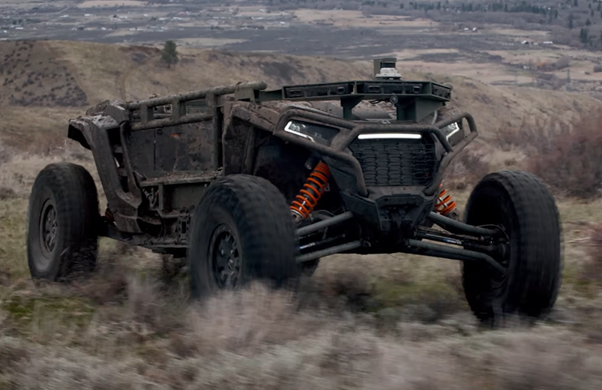
A new integration aims to close that gap by combining ground autonomy with onboard counter-drone capabilities. The ULTRA unmanned ground vehicle, developed by Overland AI, is now equipped with DroneShield’s DroneSentry-X Mk2 system. The addition enables the platform not only to navigate difficult terrain independently, but also to monitor and respond to aerial threats in real time.
According to NextGenDefense, at the core of the upgrade is a software-defined counter-UAS system designed to detect and track drones using radio-frequency analysis. The system’s AI-driven engine can identify both known and unfamiliar drone signatures, allowing earlier warning and response before a threat gets within effective range. Unlike fixed installations, the capability is embedded directly into the vehicle, supporting mobile operations and extending situational awareness beyond the ground domain.
The platform itself is built for demanding environments. It combines autonomous navigation software with a rugged chassis and a multi-layered sensor suite that includes stereo vision, LiDAR, thermal imaging, and inertial measurement systems. It is also designed to function in GPS-denied conditions, a critical requirement in contested environments. With a payload capacity of up to 454 kgs, the vehicle can be configured for a range of missions, including logistics support, sensor deployment, casualty evacuation, and handling of hazardous materials.
From a defense perspective, the integration reflects a broader shift toward multi-domain awareness at the tactical level. As small drones become more accessible and widely used in conflict zones, ground systems must be able to detect and react to airborne threats without relying on external protection layers.
Embedding counter-drone capabilities directly into unmanned platforms reduces dependency on additional assets and allows forces to operate with a smaller footprint while maintaining operational continuity.