This post is also available in:
 עברית (Hebrew)
Tracking submarines across vast ocean areas is one of the most resource-intensive missions in naval operations. Traditional platforms, such as crewed ships and aircraft, offer capability, but they come with high costs, limited endurance, and constant risk to personnel. Maintaining persistent coverage over thousands of miles remains a significant operational challenge.
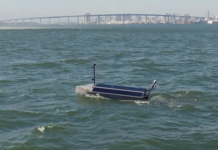
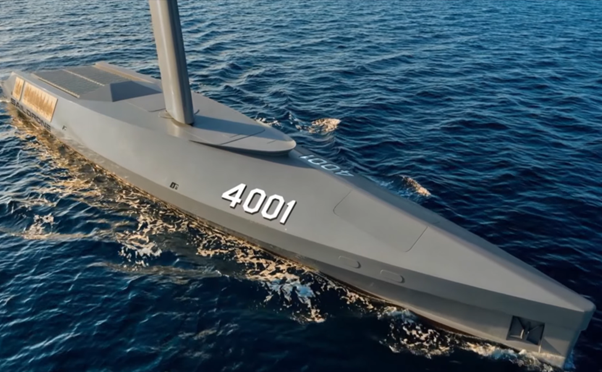
A new class of unmanned surface vessel, called Spectre (developed by Saildrone), is designed to address this gap by combining long-range endurance with low detectability. Built as a large autonomous platform, it can operate across distances of up to 14,816 kms while maintaining a relatively quiet acoustic profile, which is an essential factor in anti-submarine missions.
According to Interesting Engineering, the system is offered in two configurations, each tailored to different operational needs. One version uses wind-assisted propulsion through a large composite wing, allowing it to travel quietly over long durations with minimal energy consumption. This makes it suitable for extended tracking missions where stealth and endurance are critical.
The second configuration focuses on speed and flexibility. It combines diesel engines with electric propulsion, enabling higher-speed movement when required (up to 14,800 kms at 56 kmph), while still allowing quieter operation at lower speeds. This hybrid approach provides a balance between rapid response and reduced acoustic signature.
Both variants are designed with modular payload capacity, allowing integration of sensors and mission systems depending on the task. The platform can carry a substantial load (up to 25 tons), supporting a range of surveillance and detection equipment. Its size and endurance enable it to function as a persistent presence in areas where continuous monitoring is required.
From a defense perspective, unmanned systems of this type reflect a shift toward distributed maritime operations. By deploying autonomous vessels, navies can expand coverage without increasing reliance on crewed platforms. This reduces operational risk while allowing more assets to be positioned across large areas.
The emphasis on acoustic discretion is particularly important. In underwater environments, detection often depends on sound, and quieter platforms have a clear advantage in tracking submerged targets.
As maritime operations evolve, systems that combine endurance, autonomy, and modular capability are becoming an increasingly important part of how naval forces maintain awareness and control across wide ocean spaces.