

This post is also available in:
 עברית (Hebrew)
Airborne forces are designed for rapid deployment, but they often face a critical limitation once on the ground: lack of immediate heavy support. While troops can be inserted quickly, armored vehicles typically require secured airstrips or follow-on transport, creating a gap between arrival and operational readiness.
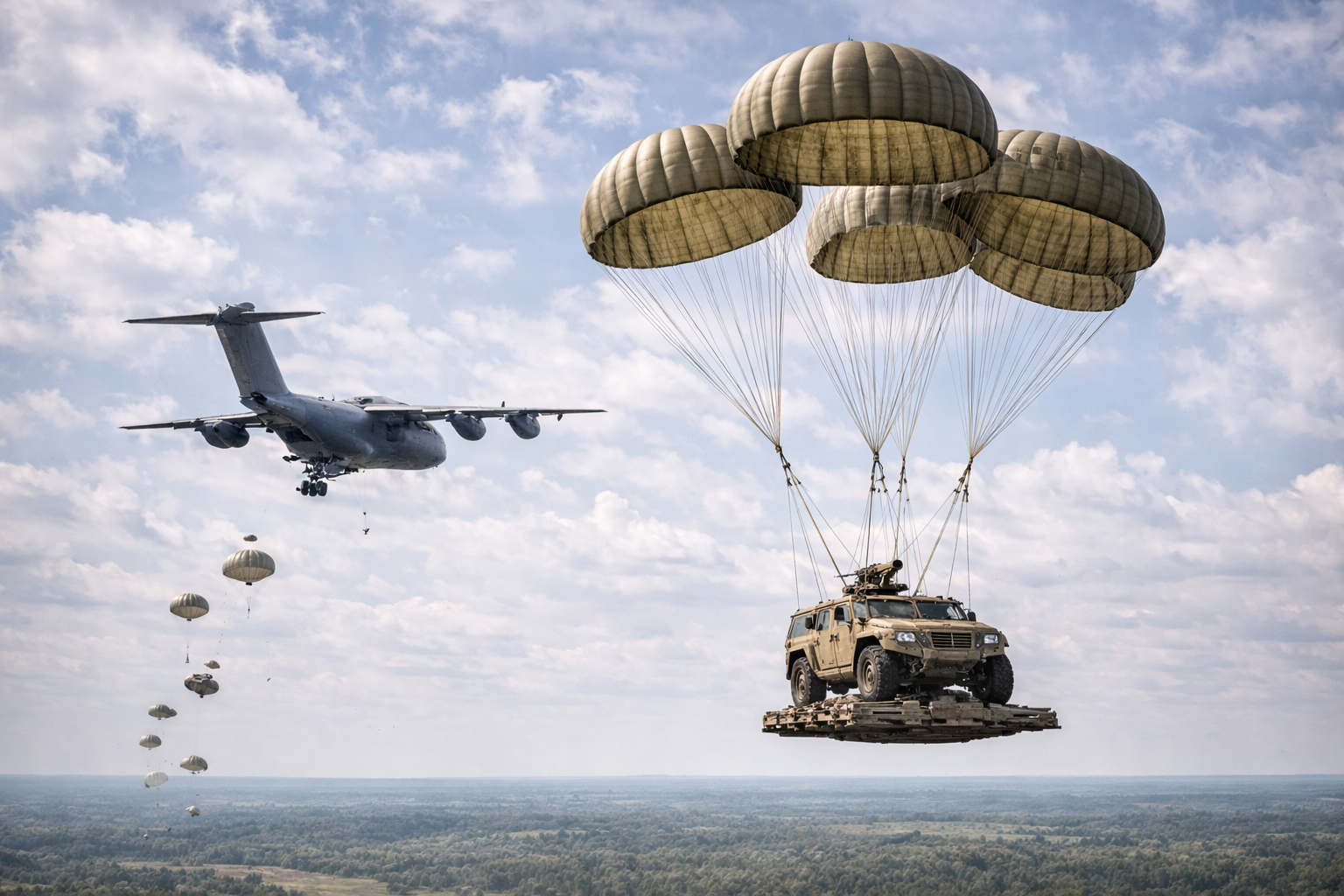
A recent test that was conducted in Germany with their “Wiesel” (weasel) vehicle, demonstrates a new approach to closing that gap by enabling direct airdrop of a light armored vehicle. Instead of waiting for infrastructure, the system allows both personnel and equipment to be delivered simultaneously into the same area. The vehicle is released from a transport aircraft using a parachute system and lands with the help of shock-absorbing airbags, allowing it to be operational shortly after touchdown.
According to Interesting Engineering, the platform itself is designed for mobility and compactness. Weighing under five tons, it is significantly lighter than most armored vehicles, making it suitable for airborne operations. Its tracked configuration provides maneuverability across varied terrain, while its size allows it to be transported by multiple aircraft types. Despite its small footprint, it can be equipped for reconnaissance, fire support, or air defense roles.
The airdrop system is built around a reinforced cage and multi-parachute setup that stabilizes descent and ensures controlled landing. Accuracy is a key factor, with the system designed to deliver the vehicle close to a designated landing zone. This reduces the time needed to regroup and begin operations after insertion.
One of the more notable aspects is the speed of deployment. Once on the ground, the vehicle can be driven off its platform with minimal preparation. This allows units to move quickly from insertion to mission execution, which is particularly important in time-sensitive scenarios.
From a defense perspective, this capability reflects a broader shift toward rapid, flexible deployment models. Delivering armored support directly into contested or remote areas can improve survivability and operational effectiveness in the early stages of an operation.
While lightweight platforms offer limited protection compared to heavier systems, their mobility and ease of deployment provide a different kind of advantage. As airborne operations continue to evolve, combining speed of insertion with immediate support is likely to become a key focus area.























