

This post is also available in:
 עברית (Hebrew)
Written by Or Shalom
Over the past decade, the world of unmanned systems has undergone a profound transformation: from specialized, expensive, and complex platforms operated exclusively by elite units, to operational “consumables” that now form the backbone of modern battlefields and civilian security frameworks. Drone usage has expanded beyond military applications into the protection of strategic facilities, border security, and monitoring of critical infrastructure such as energy, water, and communications systems, where they serve as force multipliers enabling operational continuity under threat. However, as reliance on drones increases across both defense and civilian domains, new vulnerabilities are emerging. These systems are exposed to electronic warfare, GPS disruption, and cyber intrusions, which can turn them from security assets into liabilities. This vulnerability not only influences operational effectiveness but also undermines manufacturers’ competitive positioning in a highly contested global market.
This analysis aims to provide a strategic roadmap for decision-makers, planners, and developers. In the current environment, traditional performance metrics—such as range, endurance, and payload—are no longer sufficient to secure contracts, meet stringent regulatory requirements, or ensure operational survivability. Achieving a competitive advantage now requires early integration, already at the design stage, of four core elements that increasingly shape market demand: Cost Attainability, Ease of Use, Supply Chain Sovereignty, and built-in Cyber-Hardening.
Cost Attainability
At the center of this shift lies the concept of cost attainability, representing one of the most significant recent changes in defense industry thinking. Whereas UAV markets were once dominated by expensive platforms whose loss carried strategic implications, modern battlefields demand systems that are inexpensive enough to be expendable yet effective enough to deliver decisive impact. This trend is reinforced by large-scale procurement initiatives such as the Pentagon’s Replicator program, which aims to deploy hundreds of thousands of attack drones by 2028, signaling a clear preference for optimizing the balance between quantity and quality [1]. For designers and decision-makers, this translates into adopting “Design-to-Cost” principles from the outset—prioritizing modularity, simplified manufacturing, and the use of commercial off-the-shelf components (COTS) to enable mass production without excessive cost drivers. Manufacturers capable of delivering lethal yet affordable systems provide operational commanders with greater tactical flexibility and will likely dominate a market increasingly shaped by attrition warfare and aerial swarming concepts. The Pentagon’s recent Gauntlet competition, involving 25 vendors testing one-way attack drones, further illustrates this shift toward scalable, low-cost ecosystems. The Gauntlet competition effectively serves as a testing ground for filtering solutions that meet Design-to-Cost criteria, with a particular emphasis on the ability of small and medium-sized manufacturers to deliver lethal systems at a price point that enables high levels of attainability [2].
Operational Flexibility and Ease of Use
The second pillar of competitive advantage is operational flexibility and the democratization of drone use. As drones become organic tools across all levels of operations, the primary requirement is a drastic reduction in training time and reliance on specialized operators. In this model, infantry soldiers, security personnel, or patrol officers can operate drones as part of their standard equipment (such as their vest or weapon). This shift is enabled by AI-driven autonomy, which reduces the need for complex manual piloting. Systems now manage flight stability, altitude control, obstacle avoidance in real-time, and return-to-home functions, with the press of a button. Intuitive Human-Machine Interfaces (HMI), resembling familiar smartphone or tablet environments, which soldiers use on a daily basis, allow this flexibility. The focus is moving from manual control to autonomous mission management, where onboard AI handles navigation, stability, and object detection. Systems that enable effective operation with minimal training provide significant value, providing armies with more flexible and available manpower, and create significant added value in tenders where ease of operation constitutes a critical threshold criterion, no less important than the flight performance itself. Here, too, practical validation of the critical need for ease of operation and operational flexibility was demonstrated as a part of the Gauntlet competition. The competition also focused on the ability of soldiers to operate these systems under pressure and in real time.
System Resilience and Secure Development
As unmanned systems proliferate across diverse sectors, the need for robust security and resilient supply chains becomes increasingly critical. The widespread use of commercial components (COTS) without uniform regulation introduces vulnerabilities, including remote takeover, hostile use, and Reverse Engineering if systems are captured. Addressing these risks requires a holistic “Security by Design” approach, implemented from the earliest development stages. This includes compliance with stringent international standards such as the U.S. National Defense Authorization Act (NDAA), which restricts the use of components from high-risk sources, as well as inclusion in certification frameworks like the DoD’s Blue UAS Cleared list and complementary Green UAS standards, which extend cybersecurity and supply chain assurance controls to the broader civilian and governmental markets [3].
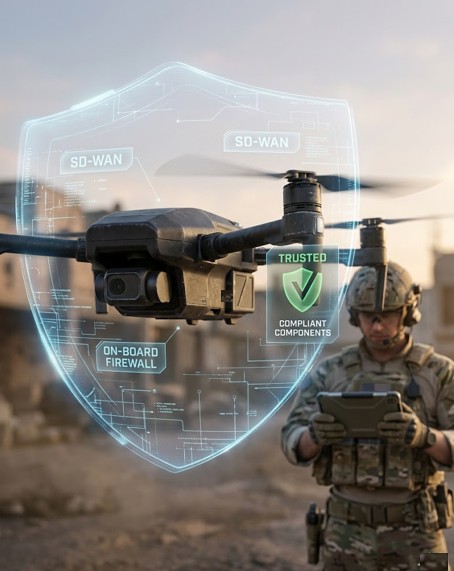
Operational resilience is built on three primary layers: hardware protection mechanisms such as Anti-Tamper components and signed firmware; self-protection capabilities (a Kill Switch), enabling data deletion or system disablement in case of loss of control; and secure communications with network redundancy. One emerging technological approach is the integration of SD-WAN architectures, as demonstrated in recent academic research in Adelaide, Australia, allowing drones to dynamically switch between multiple communication channels while incorporating onboard firewalls [4]. A significant technological foundation for the concept of on-board resilience can be found in recent research focusing on SD-WAN (Software-Defined Wide Area Networking) architectures for unmanned systems. The study presents an approach to addressing cyber threats and communication disruptions by embedding the protection layer directly within the platform itself. Under this model, the drone no longer depends on a single, vulnerable communication channel, but instead manages multiple links simultaneously—such as cellular, Wi-Fi, and dedicated radio—switching between them autonomously in the event of interference or hostile intrusion. These capabilities enable the system to monitor suspicious data traffic, isolate malicious activity, and prevent the injection of harmful commands that could lead to takeover. For developers and manufacturers, adopting these principles exemplifies the implementation of “Security by Design”, creating a digital safeguard that ensures operational continuity and mission integrity even in contested electromagnetic and cyber environments. This approach provides a clear competitive advantage over platforms relying on traditional, more vulnerable communication architectures, while the early integration of Trusted Components alongside active protection mechanisms strengthens both operational resilience and long-term business viability.
Ultimately, the ability to deliver a platform that is cost-effective, easy to operate, free of high-risk components, and resilient to disruption is no longer a theoretical engineering goal—it is the practical foundation for a Value Pro (Security & Cost by Design) position in the evolving global UAV market. Manufacturers that integrate these principles early in the design phase will secure advantages across three critical dimensions: sustainable profitability through the Design-to-Cost model, which enables offering a price point suitable for large-scale procurement programs such as Replicator and Gauntlet, without eroding profit margins. Second, regulatory compliance and rapid market entry are achieved through supply chain resilience; development based on the outset on components approved under NDAA and Blue UAS standards removes critical export barriers and ensures the product will not be disqualified in U.S. Department of Defense or NATO tenders due to a single non-compliant component [5]. Finally, combining democratized operation—simplifying control for any end-user operator—with built-in cyber resilience and SD-WAN-based communication redundancy provides the operational customer with a true force-multiplying platform.
The author is a security, cyber and HLS technology expert and consultant to government ministries and defense industries. He holds a master’s degree, as well as civil and national qualifications in the realm of HLS and Cyber Security. He has experience in consultation and business development for security companies and groups in matters of planning and building defense, innovation and security technology, exercises, and training in security and cyber.
[1] https://www.congress.gov/crs-product/IF12611
[2] https://drone-dominance.io/ , https://breakingdefense.com/2026/02/pentagon-picks-25-vendors-to-show-off-one-way-attack-drones-in-the-gauntlet-competition/
[3] https://www.diu.mil/blue-uas-cleared-list , https://www.auvsi.org/certification-training/green-uas/
[4] https://www.sciencedirect.com/science/article/pii/S0360835225008873?via%3Dihub
[5] https://www.congress.gov/bill/118th-congress/house-bill/2670/text , https://www.congress.gov/crs-product/IF12611























