This post is also available in:
 עברית (Hebrew)
Modern soldiers can receive information from drones, sensors and other units, but getting that data to the person who needs it becomes difficult when communications are disrupted. Even when information is available, frontline personnel cannot constantly look at laptops or command-center displays while moving through a contested environment.
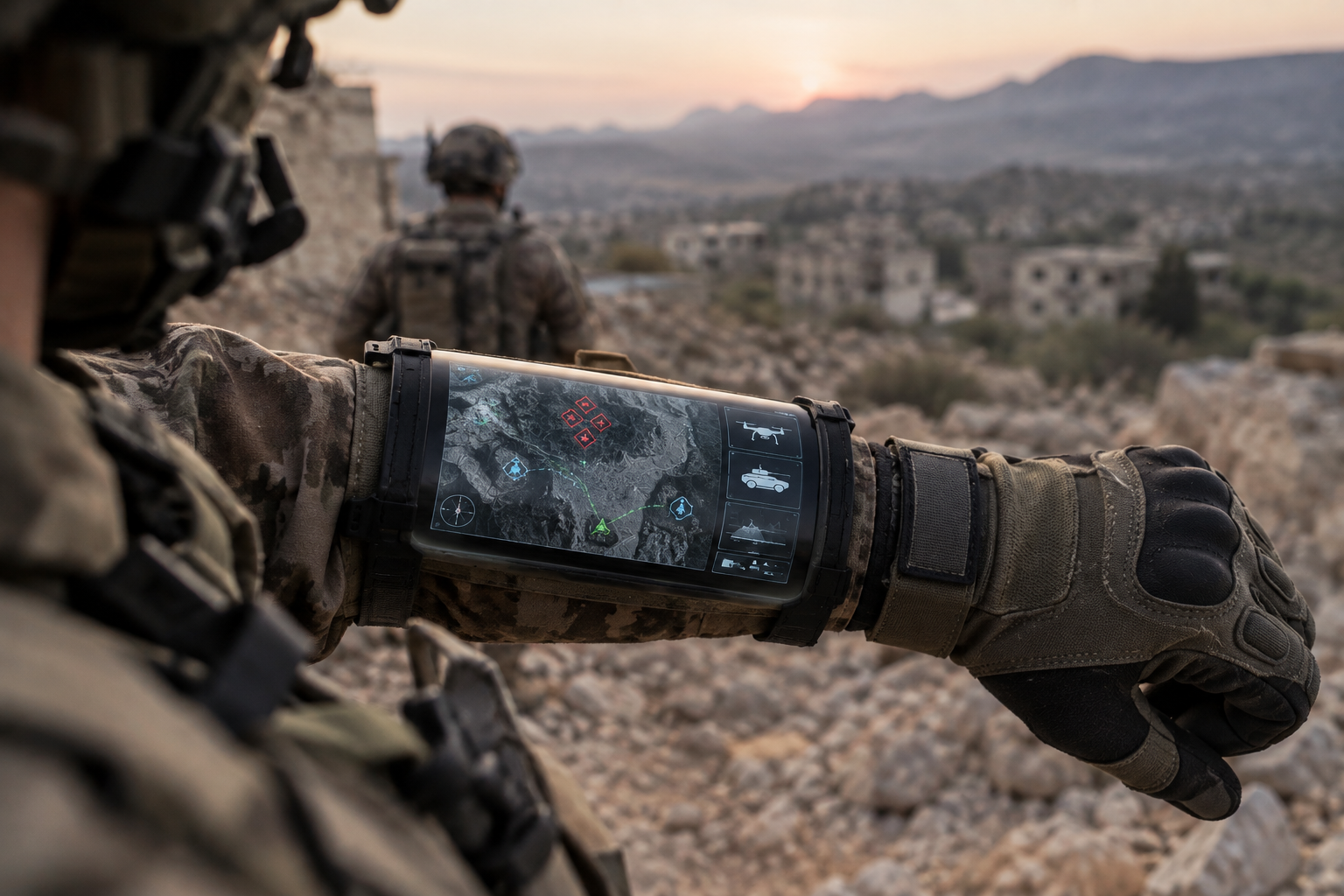
A new wearable called Alpha is being developed to put AI-processed battlefield information directly on a soldier’s forearm. Created by Smack Technologies, the device works alongside the company’s Omega AI software, which analyzes operational and sensor data before presenting relevant information to personnel in the field.
The software can process information about hostile forces and their locations, then provide Alpha users with an updated picture of the situation. The system is also intended to present possible courses of action based on factors including the mission objective, operational restrictions and the activities of nearby friendly units.
The wearable itself uses a flexible display mounted around the forearm. The concept resembles the play sleeves used by quarterbacks: information remains immediately accessible, but the wearer does not need to hold another device or keep a screen permanently in front of their eyes.
That design is particularly intended for hot, humid and heavily vegetated environments. According to Military AI, helmet-mounted displays can place information directly in a soldier’s line of sight, but they may also obstruct vision or become cumbersome in some conditions. A wrist display leaves the operator’s natural field of view unobstructed.
The more difficult challenge is ensuring that the AI remains useful when battlefield networks are unreliable. The company says the wearable is being designed to operate with field hardware under conditions of little or no connectivity, rather than functioning simply as a remote screen for a cloud-based AI system.
That places more emphasis on processing at the tactical edge, where data and AI capabilities remain close to the personnel using them. If communications with higher headquarters are interrupted, operators could still retain relevant context instead of losing access to the digital systems supporting the mission.
The company describes the software and wearable together as an “Intelligent Autonomy” architecture. The software provides the broader AI layer, while the wearable brings selected information to distributed personnel closer to the action.
Importantly, the system is not intended to make combat decisions autonomously. Its role is to organize and present information so that human operators remain responsible for deciding what to do.
The company recently raised $61 million in Series B funding to continue developing the technology.
The wearable reflects a wider shift in military AI. The challenge is no longer simply building algorithms capable of processing battlefield information, but making their conclusions useful to someone operating far from a data center, under pressure and potentially without a reliable connection. In this case, the answer may be to move the AI interface from the command post to the soldier’s wrist.