This post is also available in:
 עברית (Hebrew)
Maritime surveillance requires military forces to monitor enormous areas while identifying ships, submarines and other potential threats as quickly as possible. Crewed patrol aircraft can investigate contacts and conduct complex missions, but keeping them airborne continuously is expensive and demanding. Long-endurance unmanned aircraft offer persistent coverage, yet their effectiveness increases considerably when the information they collect can be passed directly to crewed platforms without lengthy manual coordination.
A new technology demonstration has shown how those two capabilities could work together. Northrop Grumman and Boeing demonstrated enhanced interoperability between the MQ-4C Triton unmanned surveillance aircraft and the P-8A Poseidon maritime patrol aircraft, allowing the platforms to exchange mission instructions and intelligence through standardized digital interfaces.
At the center of the demonstration were the Universal Command & Control Interface (UCI) and Open Mission Systems (OMS) architecture. Instead of creating a dedicated connection specifically between the two aircraft, these standards provide a common digital language that different military platforms can use to exchange information.
During the laboratory test, a patrol aircraft operator sent machine-readable instructions to a simulated unmanned surveillance aircraft, directing it toward a designated area. From that point, the unmanned aircraft handled much of the mission independently. It planned its route, traveled to the assigned location, operated its sensors, processed the information onboard and transmitted its findings back to the maritime patrol aircraft.
The demonstration also incorporated satellite relay communications, creating a more representative long-range operational environment. According to Interesting Engineering, the ability to send objectives rather than manually controlling every movement represents an important element of manned-unmanned teaming: human crews decide what needs to be accomplished, while autonomous systems determine how to perform routine portions of the task.
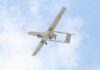
The two aircraft bring complementary capabilities. The unmanned surveillance aircraft is a high-altitude, long-endurance UAV capable of operating above 15.4 kms for more than 24 hours, providing persistent intelligence, surveillance, reconnaissance and targeting across large maritime areas. The crewed patrol aircraft, meanwhile, performs missions including anti-submarine warfare, anti-surface warfare, ISR and search and rescue.
Combining them could allow the unmanned surveillance aircraft to perform wide-area searches before sending relevant information directly to a maritime patrol aircraft, whose crew can concentrate on investigating or responding to contacts of interest. Machine-to-machine communication could also reduce the number of operators and intermediary systems needed to transfer information between platforms.
The wider significance is interoperability. Because UCI and OMS are standards-based rather than proprietary links between two specific aircraft, the same approach could eventually connect additional aircraft, ships, sensors and command systems.
As maritime operations become increasingly distributed, the ability of crewed and autonomous platforms to exchange tasks and intelligence directly could shorten decision-making cycles while allowing human operators to focus on tactical decisions rather than manually coordinating every stage of an unmanned mission.