

This post is also available in:
 עברית (Hebrew)
The widespread use of first-person view (FPV) attack drones has changed the way armies think about protecting armored vehicles. These inexpensive drones are capable of carrying explosive payloads and striking vulnerable points on tanks, armored personnel carriers and other military platforms with high accuracy. As a result, many forces have resorted to improvised protective structures such as metal “cope cages”, but these passive solutions have proven increasingly ineffective against agile drones that can approach from different angles.
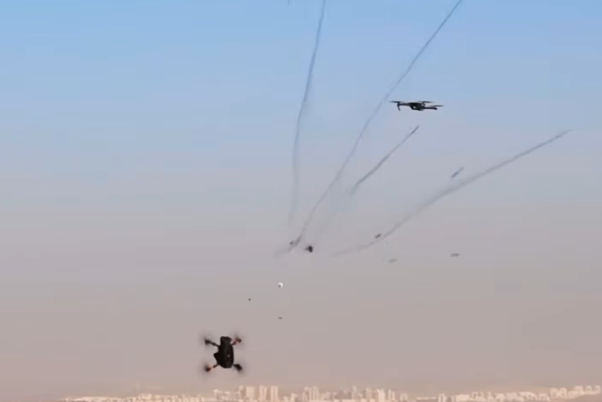
Israeli company ParaZero Technologies is taking a different approach with DefendAir, an autonomous active protection system designed to intercept FPV drones before they reach their target. Instead of reinforcing the vehicle itself, the system creates a protective zone around it, detecting incoming drones and launching a dedicated interceptor that captures the threat with a net before impact.
Unlike kinetic or explosive countermeasures, the system relies on a non-explosive interception method. Once the system’s sensors identify an approaching FPV drone, it automatically calculates the interception point and deploys a net-based interceptor, physically disabling the drone without creating blast fragments that could endanger nearby soldiers, civilians or friendly equipment. The entire engagement takes place without requiring an operator to manually respond, allowing the system to react within seconds.
According to Interesting Engineering, the platform provides 360-degree protection, enabling it to defend against attacks approaching from any direction. It is intended to protect both moving military vehicles and stationary assets such as command posts, logistics sites or other high-value equipment. Because the system can be installed on existing armored vehicles, it offers militaries a way to upgrade current fleets without redesigning the vehicles or adding the significant weight associated with additional armor.
The technology reflects a broader shift in military vehicle protection. Rather than relying solely on passive armor to absorb an attack, armed forces are increasingly adopting active defense systems that attempt to neutralize threats before they make contact. While hard-kill systems often use explosive interceptors, this system introduces another option by physically capturing incoming drones instead.
The company says it is continuing to develop the platform in cooperation with major defense companies to adapt the system to operational military requirements. As FPV drones become a standard feature of modern conflicts, autonomous counter-drone systems like this are expected to play a growing role in protecting vehicles and maintaining freedom of movement on the battlefield.























