

This post is also available in:
 עברית (Hebrew)
The growing use of drones in both military and civilian environments is creating a new type of threat that traditional air defenses are not always designed to handle. Small unmanned systems can be deployed in large numbers, fly at low altitudes, and even operate via fiber-optic links that make them resistant to conventional jamming. Protecting sensitive sites, whether military bases or critical infrastructure, now requires systems that can respond quickly, cover wide areas, and deal with multiple targets at once.
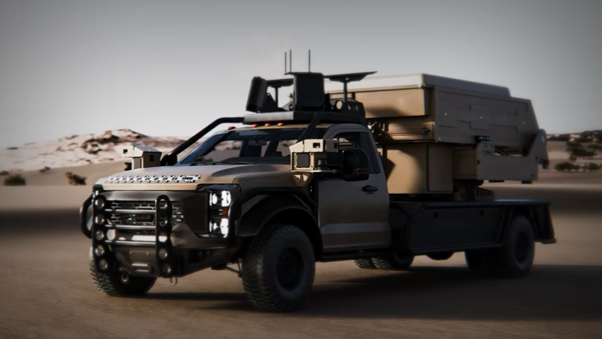
A new mobile counter-drone platform aims to address these challenges by combining autonomous mobility with directed electromagnetic effects. Built on a heavy-duty truck chassis, the system integrates a high-power microwave weapon with a self-driving capability, allowing it to move independently or be remotely operated. This enables it to patrol perimeters, reposition to interception points, or maintain coverage across large and dynamic areas without constant human control.
At the core of the system is a microwave-based payload designed to disrupt the electronics of incoming drones. Unlike traditional approaches that rely on physical interceptors or narrow-band jamming, high-power microwave energy can affect multiple targets simultaneously. According to NextGenDefense, this makes it particularly suited for countering drone swarms, where engaging each target individually would be inefficient or too slow.
The platform’s autonomous driving system adds another layer of flexibility. It can operate on both structured roads and unstructured terrain, allowing it to adapt to different operational environments. This reduces the need for dedicated crews and supports continuous operation, especially in scenarios where human presence may be limited or exposed to risk.
From a systems perspective, the platform is modular, enabling integration of different components and future upgrades. This allows it to evolve alongside emerging threats, particularly as drone technology becomes more diverse and harder to counter with single-purpose solutions.
In defense and homeland security contexts, such capabilities are increasingly relevant. Mobile counter-UAS systems can be deployed to protect military installations, border areas, airports, ports, and large public events. The ability to combine autonomous movement with wide-area electromagnetic effects reflects a broader shift toward flexible, scalable defenses against fast-changing aerial threats.
As drone tactics continue to evolve, solutions that merge mobility, automation, and multi-target engagement are likely to become a central part of layered air defense strategies.























