

This post is also available in:
 עברית (Hebrew)
Identifying military equipment quickly and accurately remains a challenge, particularly in fast-moving operational or training environments. Analysts and personnel often rely on manual comparison, reference materials, or prior experience to classify vehicles, weapons, and systems. This process can be time-consuming and prone to error, especially when dealing with unfamiliar platforms or limited visual data.
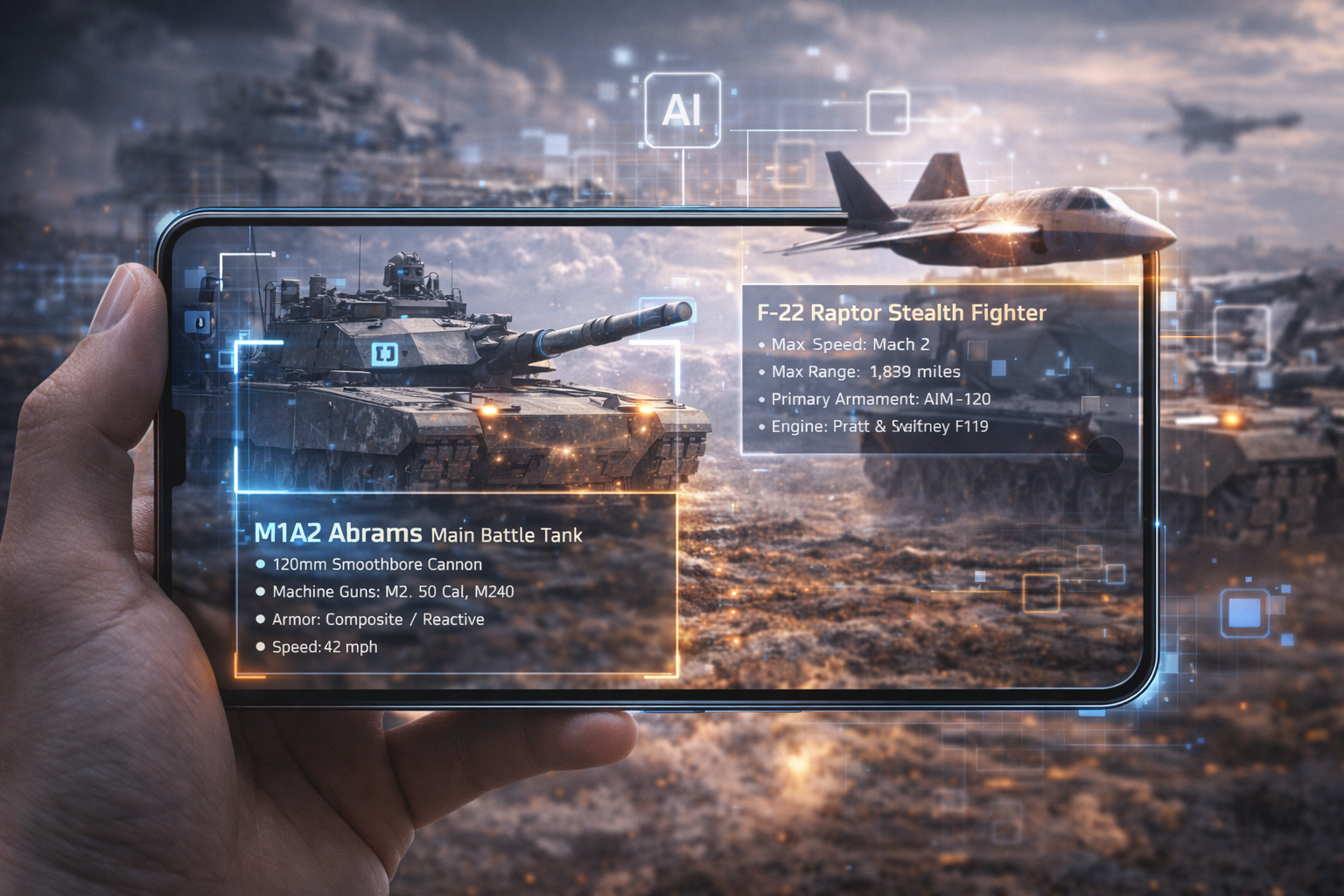
A new Belgian artificial intelligence platform (by IDDEA) aims to streamline this task by automating image-based identification. The system analyzes photos of military equipment and matches them against a structured database, delivering detailed technical information within seconds. Instead of relying on manual interpretation, users receive organized data that can be used immediately for analysis or training.
At the core of the platform is an image recognition engine trained to detect and classify a wide range of military systems. Once an image is uploaded or captured, the system compares visual features against a database containing more than 1,700 entries. These include armored vehicles, artillery systems, missile platforms, air defense units, radars, and tactical vehicles from multiple regions.
According to NextGenDefense, the output goes beyond simple identification. It presents structured information such as system designation, key characteristics, armament, and mobility features. This allows users not only to recognize a platform, but also to understand its operational role and capabilities.
Another key feature is its design for offline use. The entire dataset, just over 200 megabytes, can be stored locally on a device, enabling the platform to function without an internet connection. This makes it suitable for field environments, training exercises, or scenarios where connectivity is limited or restricted.
The system also supports training applications by offering visual references from multiple angles and highlighting distinguishing features between similar platforms. This helps users build recognition skills over time, improving both speed and accuracy.
From a defense perspective, tools like this can enhance situational awareness by reducing the time required to interpret visual intelligence. Rapid identification of equipment can support decision-making in reconnaissance, intelligence analysis, and operational planning. The ability to operate offline further strengthens its relevance in contested or remote environments where access to centralized databases may not be available.
As image-based intelligence becomes more central to modern operations, automated recognition systems are likely to play an increasing role in both training and real-world scenarios.























