

This post is also available in:
 עברית (Hebrew)
Written by Or Shalom
The 2026 FIFA World Cup, set to be jointly hosted by the United States, Mexico and Canada, is not merely another global sporting event but a mega-event representing one of the most complex security, logistical and technological challenges of the current decade. The tournament breaks historical precedents: it will span 16 host cities across three countries, for the first time featuring 48 national teams and 104 matches and is expected to attract more than five million international visitors. Its overlap with the America250 celebrations, marking 250 years of U.S. independence, significantly heightens the threat profile, turning match venues into strategically sensitive and nationally significant targets.
To understand the scale of the required security measures, one must first examine how U.S. authorities classify the threat environment. The Department of Homeland Security (DHS) evaluates major public events using the Special Event Assessment Rating (SEAR) system. This formal framework determines the level of federal security resources and assistance required in advance. The methodology assesses three core variables: Threat, Vulnerability and Consequences. The levels range from 1 to 5, with Levels 1 and 2 reserved for the highest-profile events requiring direct federal involvement. In an unprecedented move for a prolonged sporting event, all 78 matches to be held in the United States were marked as SEAR 1 or SEAR 2. Strategically, this means each match is treated not as a local sporting event but as a nationally sensitive target, requiring a security coverage comparable to that of a federal facility or special events such as the Super Bowl. This classification forms the legal and budgetary basis for the historic $625 million Federal World Cup Grant Program (FWCGP) [1], effectively obligating host cities to move beyond traditional policing models and integrate advanced technologies.
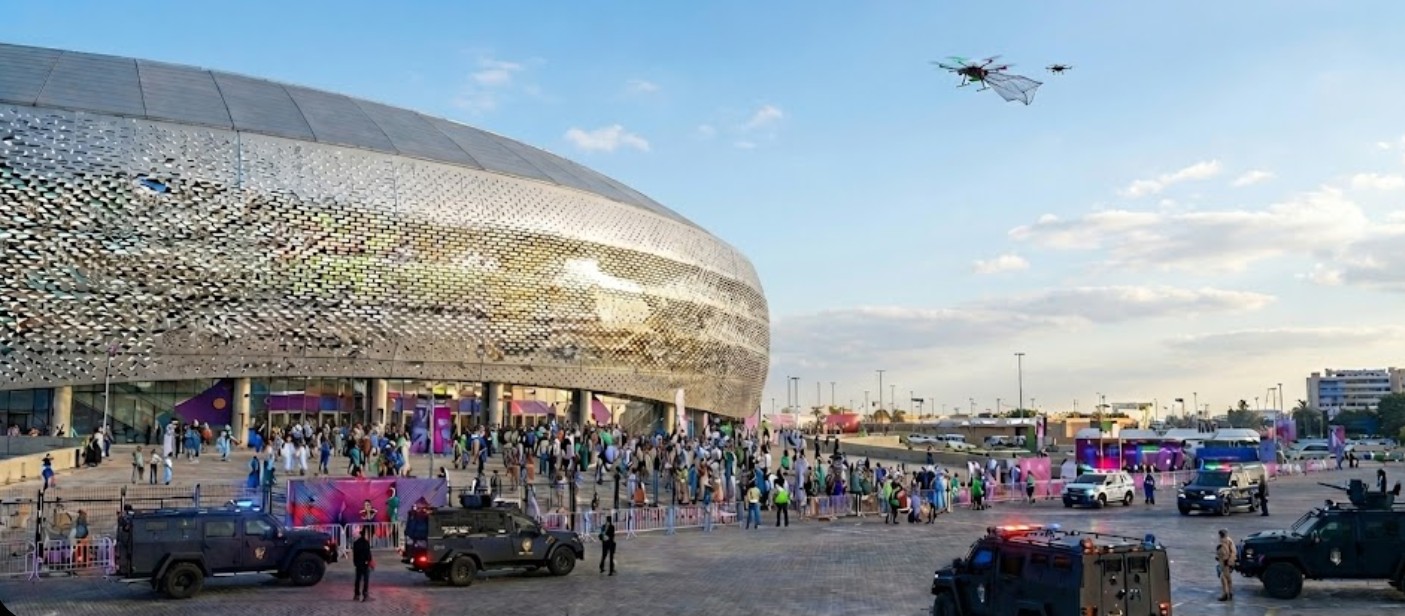
Against this elevated threat backdrop, one of the most complex challenges is protecting stadium airspace from unmanned aerial systems (UAS). Reflecting a shift toward proactive defense, the DHS established a dedicated program backed by $115 million to address drone threats. As part of this initiative, Fortem Technologies was selected as the exclusive provider of kinetic mitigation solutions for 11 U.S. host cities [2]. The technological and regulatory constraints of operating in dense civilian environments created a security gap that led decision-makers to adopt a Safe Kinetic Mitigation approach [3].
This concept relies on an AI-guided autonomous interceptor drone that locks onto a hostile target and captures it midair using a net. The system neutralizes the threat in a controlled manner, relocates it to a sterile landing zone and ensures Zero Collateral Damage in crowded urban environments. This interesting choice reflects three main considerations:
First, safety and regulatory limitations in civilian settings restrict the use of traditional radio-frequency jamming, which could disrupt sensitive stadium communications systems. On the other hand, conventional Hard-Kill methods risk debris falling into spectator areas.
Second, operational precedent and dealing with unmanned vehicles (UAVs): lessons were learned from the 2022 World Cup in Qatar, demonstrating that Fortem’s physical capture technology provided the most effective response, particularly against fully autonomous drones, seeing as they do not rely on radio signals that can be jammed, but navigate via preprogrammed waypoints [4].
Third, systemic effectiveness gaps: traditional defense systems struggle with three main challenges. When it comes to the physical aspect (stealth), small, slow-moving drones have minimal radar and thermal signatures and fly at low altitude in order to easily avoid detection. Simultaneously, when it comes to data (environmental noise), multi-sensor arrays in urban environments often generate conflicting or noisy data, increasing false positives and eroding operator trust. Moreover, when it comes to the operational aspect (reaction time), the need to detect, classify and respond imminently to a moving aerial threat demands decision-making speeds that surpass what humans are capable of.
The holistic solution integrates three technological layers; the first layer focuses on detection and classification using compact radar systems, which are capable of identifying low-signature targets while applying edge-based machine learning to filter environmental noise and dramatically reduce false positives. Data flows into a second layer, which is an AI-driven command-and-control (C2) platform that fuses information in real time and autonomously determines interception decisions, without human involvement, thus addressing their reaction time limitations. The final layer, of kinetic interception, consists of an autonomous interceptor drone, which constitutes an alternative to traditional approaches. Equipped with onboard radar, it locks in on the target, deploys a net and either tows the drone or lowers it via parachute into a sterile zone. This ensures Zero Collateral Damage, prevents debris from endangering spectators and enables surgical neutralization consistent with the Safe Kinetic Mitigation doctrine.
This case study proves that a holistic and multi-layered solution, which integrates edge radars, AI and autonomous interceptor platforms, can bridge the gaps in the physical, data and operational aspects. The adoption of the Safe Kinetic Mitigation approach extends beyond a single event. It represents the emergence of a Gold Standard for protecting critical infrastructure and mass gatherings from autonomous threats while maximizing public safety. At the same time, this interception architecture is likely only one component within a broader, layered security concept incorporating Defense-in-Depth, to ensure operational resilience, provide comprehensive protection and hermetic security backup for any and all diverse threat scenarios.
The author is a security, cyber and HLS technology expert and consultant to government ministries and defense industries. He holds a master’s degree, as well as civil and national qualifications in the realm of HLS and Cyber Security. He has experience in consultation and business development for security companies and groups in matters of planning and building defense, innovation and security technology, exercises, and training in security and cyber.
[1] https://www.fema.gov/fact-sheet/notice-funding-opportunity-nofo-fifa-world-cup























