

This post is also available in:
 עברית (Hebrew)
Modern naval forces face an increasingly complex underwater picture. Quieter submarines, dense maritime traffic and the growing risk of seabed mines make persistent undersea surveillance both critical and resource-intensive. Manned submarines and surface vessels cannot continuously cover vast areas without significant cost and operational strain.
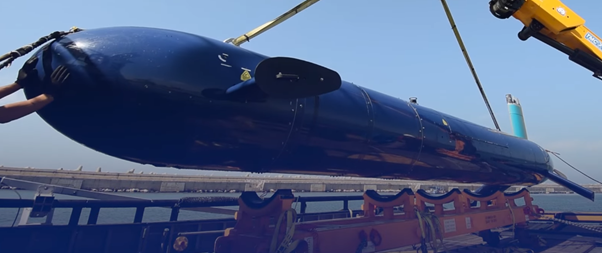
An autonomous underwater vehicle known as BlueWhale is designed to address this gap by functioning as a long-endurance, unmanned sensor platform. The large autonomous submarine has now been delivered to the German Navy following a series of operational trials in the Baltic Sea, an environment known for challenging acoustic conditions.
It combines reconnaissance, target detection and onboard data processing within a single system. Equipped with an advanced sensor suite, it can detect and track objects both above and below the surface, gather acoustic intelligence and identify sea mines resting on the seabed. A towed sonar array enhances its anti-submarine warfare capabilities, improving detection performance in complex waters.
According to Interesting Engineering, a key feature of the platform is its onboard data fusion and processing architecture. Rather than relying heavily on external analysis, the system processes sensor inputs internally and produces real-time outputs that can support operational decisions. This reduces bandwidth demands and allows the vehicle to operate independently for extended periods.
Designed for endurance, it uses a high-efficiency battery configuration that enables weeks of continuous deployment. Its compact structure allows transport inside a standard 12.1-meter container, supporting rapid deployment by land, air or sea. An onboard control unit manages sensors, communications and power distribution, while secure satellite links integrate the vehicle into broader command-and-control networks.
Acting as a forward, low-signature sensor asset, an autonomous submarine can extend a navy’s surveillance reach without exposing crews to risk. In anti-submarine warfare scenarios, it can patrol contested areas, collect acoustic signatures and monitor suspicious activity while manned platforms remain at a safer distance. Its mine-detection capability also supports maritime security and freedom of navigation operations.
By combining autonomy, integrated sensing and long-duration performance, the platform reflects a broader shift toward unmanned systems as core elements of next-generation naval defense architectures.























